
Traveling Light: Silicon Photonics
New chips can accelerate AI with faster data transfers
By Meghan Hauser, Ph.D. and David Perry
Modern computing, sensing, and communications are hitting an interconnect ceiling: Chips generate more data than copper wires can carry efficiently. As speeds climb, electrical links lose signal over short distances, require power-hungry cleanup circuits, and create heat and congestion at connectors. The result is that bandwidth, energy, and reach of the links now limit system performance more than the processors do.
This sets the stage for silicon and integrated photonics (SiPh), which moves bits using light instead of electrons to break through those limits in new and scalable ways. This seemingly small hardware innovation changes everything we’ve known about:
- Bandwidth
- Latency
- Power consumption
Consider China’s billion-dollar SiPh industry. From Peking University to Guangdong Province, Chinese national labs and corporations are operating at full speed to leapfrog advanced electronics. In 2022, General Secretary Xi Jinping’s remarks about SiPh were explicitly clear. It’s an area, he said, “in which our country has the conditions to achieve breakthroughs ahead of others.” Since then, China has made aggressive investments in this technology that is quietly reshaping the compute landscape—and becoming a focal point of U.S. national security and geopolitical advantage.
In the context of pressing U.S. defense and intelligence applications, it’s no surprise that SiPh was recognized in 2024 as a strategic domain by the U.S. House of Representatives' select committee on China. Early movers will lead in AI, quantum computing, sensing, and space-based systems—so active engagement today offers the chance to shape supply chain security and trusted hardware development in the face of adversarial investment.
Over the next two to five years, silicon and integrated photonics will become central to the future mission, with the power to enable underlying technology across virtually every national system. With analysis and insights from the Booz Allen Tech Scouting and Intelligence team, we examine where the market trends are heading and immediate considerations for federal government leaders and the U.S. innovation industry.
Speed Read
Silicon photonics (SiPh) is set to revolutionize data transfer, offering higher bandwidth, lower latency, and improved energy efficiency by addressing limitations in traditional copper and electronic interconnects.
China and the United States are competing for geopolitical dominance in silicon photonics technology, with China making significant investments and the United States recognizing its strategic importance for national security and advanced computing.
The United States must prioritize SiPh adoption and innovation, with support for domestic R&D and manufacturing, to maintain leadership in advanced technologies such as AI, quantum computing, and secure communications.
Technology at a Glimpse
In 2024 research, our Tech Scouting and Intelligence team discussed how photonics is “an attractive new approach to data transfer—both on- and off-chip—given its added benefits of speed, bandwidth, and low heat generation.” Since that original research was published, the SiPh market has grown rapidly and has shown the potential to transform a myriad of technologies as the AI industry demands increased compute performance at lower cost and higher efficiency.
SiPh goes beyond Moore's Law to break the efficiency wall that limits all-electronic devices.
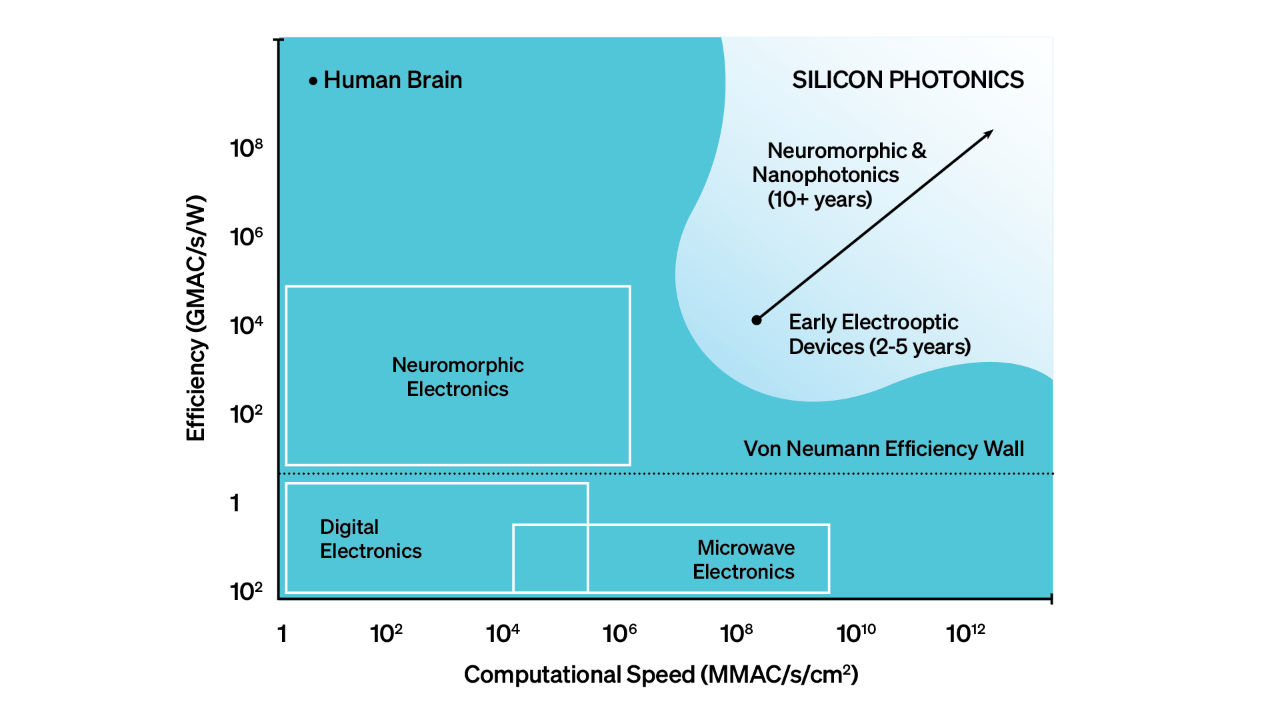
SiPh enables the integration of optical components onto a single silicon (or silicon-based material like silicon nitride or silicon-on-insulator) chip leveraging standard complementary metal oxide semiconductor processes. It leverages existing semiconductor manufacturing techniques to simplify this evolution.
The resulting devices use light (photons) instead of electrical signals, which overcomes many limitations of traditional copper- and electron-based devices. These photonic integrated circuits (PIC) are highly versatile and can efficiently generate, manipulate, and transmit light at high speeds and low power, making them valuable across many applications.
Key Benefits of SiPh vs. Traditional Electronics
Energy Efficiency
Heat matters: The more heat, the more wasted energy, cooling costs, stress on components—and the less space there is to add processors and memory without the risk of melting. SiPh devices can be more energy-efficient since using light, rather than electrical currents, reduces resistive heating and power loss. Additionally, photonic interconnects can achieve high-speed data transfer with lower energy consumption by minimizing the need for power-hungry repeaters and buffers.
Signal Integrity / Interconnect Reach
Electrical interconnects lose their signal strength over increasingly long distances and suffer crosstalk and interference. On the other hand, photons don’t suffer from resistive losses, parasitic effects, or electromagnetic interference, maintaining signal integrity over long distances. Optical interconnects also reduce signal propagation delays, as photons experience less dispersion compared with electrical signals.
Latency
Electrical interconnects are constrained by resistive-capacitive delays and require signals to be constantly boosted, converted, and cleaned up—all of which accumulates latency as data moves across a system. Photonic links avoid these bottlenecks by transmitting information optically, where waveguides experience negligible dispersion and do not require frequent regeneration. While the speed is still shaped by how fast the light signals can be turned on and off, SiPh reduces the overhead introduced by electronic signal processing, enabling lower end-to-end delay and faster communication across increasingly complex systems.
Data Rates
SiPh greatly expands the amount of information that can be moved at once, making it possible to handle the growing demands of modern computing and communications. It enables much higher data rates with wavelength division multiplexing—a technique where multiple signals are transmitted simultaneously on a single waveguide by using different wavelengths (i.e., colors) of light. As a result, while high-speed electrical interconnects have plateaued at data rates of hundreds of gigabits per second, SiPh is on track to scale up to tens of terabits per second by the end of this decade.
Spotlight Application: AI Acceleration
This technology can advance compute-intensive use cases across a number of domains. One of the most compelling is using SiPh to accelerate the performance of AI systems.
Challenge
Today’s AI computations are fundamentally limited by the “memory wall,” which is the gap between the amount of memory access needed and the amount available. This gap is growing exponentially as models become larger and more complex, but memory bandwidth is stagnating. While data center applications can address these limits through scale-up architectures, edge devices face strict limits on size, weight, and power (SWaP), meaning they cannot simply add more chips or energy-hungry cooling systems to keep up. These combined bottlenecks create mounting pressure for new approaches to move data faster and more efficiently within AI hardware.
Application
The bandwidth, signal integrity, and power advantages of SiPh directly address the memory wall by easing the flow of data between compute and memory, reducing one of the biggest bottlenecks in AI systems. By integrating on-chip optical interconnects, photonics also makes it possible to bring more compute power closer to edge sensors, enabling real-time AI inference in devices like drones, autonomous vehicles, and industrial robots.
Beyond raw bandwidth, the ability of photonics to deliver deterministic, low-latency communication supports tight synchronization across distributed sensor networks, which is critical for autonomy and situational awareness. In this setup, data is still processed electrically but transmitted optically, with PICs embedded alongside electronic integrated circuits to maximize reach, network bandwidth, and efficiency. This co-location not only supports memory disaggregation and composable AI architectures but also scale-out and scale-up systems that break the limits of traditional copper interconnects.
Shortening Distance of Optical Interconnections Leads to Greater Information Processing Capacity

Dynamics We’re Watching
#1: The geopolitical chess match is on.
Export restrictions on lithography and advanced electronics have heavily contributed to China’s SiPh indigenous development drive. Moving forward, China and the United States will compete for supremacy in the geopolitical microelectronic and SiPh race. China is aggressively investing in SiPh as part of its broader effort to secure self-sufficiency in advanced compute, sensing, and communications technologies.
China’s supply chain dominance in germanium, lithium niobate, and other rare and critical metals strengthens their hold over the silicon wafer (SW) market, needed for SiPh, and accounts for 50% of global SW production. The top five global SW producers are all Chinese, including the Shanghai Xinkehui New Material Co.
#2: Private investment is on the rise.
In 2024, private investment in SiPh grew rapidly after a year of protracted funding. The large decrease in capital allocation and stagnant deal volume in 2023 was likely due to macroeconomic factors and longer runways created from the previous two years of large, later-stage deals.
#3: U.S. federal priorities are gradually aligning.
The U.S. government still maintains a majority investment in electronic-only technologies. But there are significant efforts to accelerate development of SiPh, given its heightening role in national security priorities. The Defense Advanced Research Projects Agency (DARPA) and the Defense Sciences Office are the major drivers of Department of War (DOW) SiPh funding, with DARPA being a top catalyst for SiPh research and development over the last two decades.
What’s Next for the Technology
Projected timeline of development
It’s no accident that SiPh has reached this inflection point. Decades of research and development by both the private and public sectors, including more than 20 years of DARPA investment, have strategically accelerated SiPh applications. Already dominating data communications in the data center market, SiPh is now on the cusp of disrupting several other key fields in the next two to five years.
Over the coming years, the SWaP-C metrics of SiPh will improve sufficiently to accelerate edge AI computations and other critical edge applications.
Data Centers
Near Term (0-2 Years)
- Data center interconnects (longer distance, between systems/facilities)
- AI and HPC inter chip optical datacoms (shorter distance, within systems/racks)
Medium Term (2-5 Years)
- Intrachip optical datacoms for data center and HPC AI accelerators
- Datacoms between quantum computing chips and racks
- Spatial computing / cloud XR rendering
Long Term (5+ Years)
- Fully photonic data movement (rack-scale optics)
- Photonic AI/neuromorphic computing
- Fault tolerant photonic quantum computing
- Optical networks-on-chip (NoC)
Edge
Near Term (0-2 Years)
- LiDAR for robotics, drones, and industrial sensing
- IoT with optical sensors
- Early biomedical wearables / diagnostics and environmental sensors
- Early quantum sensors
- Secure optical links less prone to electromagnetic interference
- 5G comms
- Telecom / long-haul networking
Medium Term (2-5 Years)
- Intrachip optical comms for edge AI accelerators
- 5G / 6G edge comms
- Space comms and sensing
- Advanced biomedical / environmental sensing
- Integrated photonic transceivers for RF spectrum sensing, 6G, or optical comms
- Multimodal edge sensors
Long Term (5+ Years)
- Autonomous navigation with photonic sensor fusion
- EW with photonic front-ends
- Rad-hard computing devices for space
- XR glasses with PIC-based sensing and compute
- Distributed quantum networks
Reinforcing U.S. leadership
For long-term dominance in advanced computing, communications, space, and other technology verticals, the United States must prioritize the adoption of photonics and optoelectronics. They are the next generation of capabilities to break the limits of all-electronic solutions.
In the coming years, the federal government can leverage SiPh for:
- Secure, high-bandwidth communications that are both compact and resistant to electromagnetic interference.
- Tactical and strategic networks where low SWaP is critical, such as space environments.
- The foundational platform to manipulate quantum states of light, making them key enablers for scalable quantum systems.
- Support of next-generation sensors used in intelligence, surveillance, and reconnaissance (ISR) and electronic warfare. Applications include LiDAR, hyperspectral imaging, and quantum radio frequency sensors, among many others.
A building block for global competition
Silicon photonics will enable and transform a diverse array of industries by providing a scalable platform for manufacturing advanced devices. By marrying light waves with the ubiquitous semiconductor manufacturing used for modern electronics, SiPh technology overcomes traditional barriers in cost, performance, and scalability that have historically limited photonics adoption.
For continued progress, it will be crucial to:
- Prioritize domestic R&D and manufacturing investment into photonic and optoelectronic technologies to ensure competitive positioning in SiPh for the United States and our allies.
- Explore supply chain alternatives for key SiPh components and critical mineral resources currently controlled by China.
- Keep U.S. capital and SiPh intellectual property from China, as with other advanced semiconductor technologies crucial to the Tech Cold War.
Today’s leaders in emerging software solutions like AI must take hardware more seriously than before. Key innovations in SiPh design, materials, integration, packaging, and system-level design will unleash exponential growth in computing, sensing, quantum information technologies, telecommunications, and many more applications—some of which we have yet to discover.
About the Research
The Booz Allen Tech Scouting and Intelligence team scans the market for novel technologies with the potential to disrupt U.S. government critical missions. Delivering research, trends spotting, and deep dive technical analysis, the team is hyper-focused on getting the best technology from the private sector into the hands of the warfighter and civilian federal workforce.
New edition | v5. summer 2026
Explore the New Velocity

cover story
Reimagining Cyber for a Faster Fight
Securing enterprises against AI threats requires disrupting operating models, enriching detection, and strengthening resilience—because attacks now unfold in minutes, not days.
tech spotlight
How Can You Trust Agentic AI? Start with Engineering
Why trust must be designed, governed, and validated—not assumed.
mission spotlight
Infrastructure Under Attack: The Zero Trust Imperative
Cybersecurity must go beyond compliance to defeat new threats.
in conversation
Infrastructure to Impact with Raghu Raghuram
An interview with Raghu Raghuram, managing partner at a16z.
emerging trends
The Math that Makes Technology Trustworthy
Formal methods and automated reasoning are reshaping software and AI security.
lessons from the edge
Resilience Tops Perfection: Desiging for Failure Wins
Resilience doesn't come from preventing failure, it comes from surviving it well.
tech watch
Don't Take My Word For It: Zero-Knowledge Proofs
Trusting more (but revealing less) with zero-knowledge proofs for government.

in conversation
Infrastructure to Impact with Raghu Raghuram
An interview with Raghu Raghuram, managing partner at a16z.
emerging trends
The Math that Makes Technology Trustworthy
Formal methods and automated reasoning are reshaping software and AI security.
lessons from the edge
Resilience Tops Perfection: Desiging for Failure Wins
Resilience doesn't come from preventing failure, it comes from surviving it well.
tech watch
Don't Take My Word For It
Trusting more (but revealing less) with zero-knowledge proofs for government.
New edition | v5. summer 2026
Explore the New Velocity


cover story
Reimagining Cyber for a Faster Fight
Learn how CISOs are rebuilding to keep pace with AI-powered attacks.

tech spotlight
How Can You Trust Agentic AI? Start with Engineering
Why trust must be designed, governed, and validated—not assumed.

mission spotlight
Infrastructure Under Attack: The Zero Trust Imperative
Cybersecurity must go beyond compliance to defeat new threats.
in conversation
Infrastructure to Impact with Raghu Raghuram
An interview with Raghu Raghuram, managing partner at a16z.

emerging trends
The Math that Makes Technology Trustworthy
Formal methods and automated reasoning are reshaping software and AI security.

lessons from the edge
Resilience Tops Perfection: Designing for Failure Wins
Resilience doesn't come from preventing failure, it comes from surviving it well.

tech watch
Don't Take My Word For It: Zero-Knowledge Proofs
Trusting more (but revealing less) with zero-knowledge proofs for government.
