
Sim to Field: Physical AI Trains and Proves AI Systems
Deploying AI systems in the real-world with trust
By Munjeet Singh, Greg Kacprzynski, Randy Yamada, Ph.D., and Drew Massey
Less than a decade ago, experts predicted that 10 million self-driving cars would be on the road by 2020. This kind of optimism about autonomy—not just in vehicles, but across a slew of commercial use-cases, from factory production lines to healthcare—was widely shared at the time. As recently as 2016, Stanford University’s One Hundred Year Study on Artificial Intelligence, or AI100, predicted “We will see self-driving…delivery vehicles, flying vehicles, and trucks,” as well as cars by 2020.
Five years later, in its 2021 report, AI100 acknowledged that this prediction had been “overly optimistic.” In 2025, there are only a few thousand fully autonomous vehicles operating in the U.S. (most with human minders), out of 285 million cars and trucks on the road.
What happened? Self-driving cars have proven increasingly capable, performing as or more safely than human drivers in certain situations, like highway driving in good light conditions. But the public remains skeptical—only 13% trust the safety of autonomous vehicles—and has set high expectations.
For other use cases, the bar might be even higher: What is an acceptable error rate for autonomous defense or weapons systems? Or healthcare robots?
Speed Read
The increasing sophistication of physical AI can enhance the reliability and safety of robotics, autonomous systems, and smart environments by leveraging high-fidelity simulations and digital twins to train, test, and improve these AI systems for real-world conditions, narrowing the sim-to-real performance gap.
The integration of physical AI enables continuous learning and improving operational readiness through systematic and reproducible testing in both simulated and real-world environments, reducing the need for extensive physical trials and allowing for quicker, safer deployment of AI-powered systems.
Physical AI also offers a rigorous test–and-evaluation process that replicates real-world performance in software and verifies it before deployment, producing auditable evidence that accelerates accreditation and supports continuous updates. It is an essential tool for mission-critical applications in diverse fields such as autonomous navigation, smart manufacturing, and security.
The hard truth is when AI-enabled systems are operating in the physical world, there’s a lot that can go wrong. Reality is full of edge cases: A flash of sunlight from an unexpected angle, a unique architectural feature, a pedestrian attired or moving unusually. Deployment in a factory where the environment is controllable to a degree is very different from deployment on city streets or a battlefield.
There’s a paradox here: In some cases, autonomous systems can already surpass human performance. However, that’s still not good enough given the heightened regulation and scrutiny many missions and applications face.
In the physical world, one mistake can wreck infrastructure and put lives at risk.
Many federal missions must strive to achieve reliability, performance, and safety standards closer to the same five-nines (99.999%) required for critical infrastructure like telecommunications and in commercial aerospace. And they need to be able to demonstrate that performance against benchmarks defined in law and regulation.
Advances in physical AI offer a solution: Physical AI integrates virtual environments that replicate real-world conditions with high-fidelity, randomized simulations of actual scenarios. This combination allows for training, testing, improving, and deploying AI-powered systems at scale, through extended exposure to modeled environments, edge cases, and unique scenarios.
And these same digital world models and virtual environments can be used to address the extensive and often time-consuming validation & verification (V&V) testing needed to confirm safe and trustworthy performance of autonomous systems.
Physical AI is both a force multiplier and risk mitigator for AI-powered systems operating in the physical world—designed to push boundaries, reduce uncertainty, and enable innovation.
Physical AI: At-a-Glance
Physical AI is a branch of AI focused on enabling machines and smart sensors to perceive, understand, and perform complex actions in the physical world. Training physical AI models requires either real or synthetic data that accurately reflects real-world conditions, such as lighting, mass, motion, and contact dynamics. While virtual environments are often preferred for their cost-effectiveness and scalability, the "sim-to-real gap"—the discrepancy between simulation and reality—remains a challenge.
Fortunately, the increasing fidelity of modeling and simulation capabilities helps create more accurate world models. Additionally, techniques like domain adaptation and transfer learning are advancing to minimize errors and shrink the sim-to-real gap. This progress leads to more reliable digital replicas, or digital twins, of the real world, which serve as “digital proving grounds.” These digital twins help de-risk and accelerate the operationalization of physical AI.
The Loop That Changes Everything: A Guide for Adoption
In the last issue of Velocity, Booz Allen CTO Bill Vass introduced the concept of the modern technology flywheel. As he explained, this operating model combines real-time data, machine learning, and digital twins within a software-defined environment to create a positive feedback loop driving continuous improvement and performance optimization. Physical AI is at the heart of this model.
A physical AI stack takes existing simulation and digital twins to the next level. Instead of waiting for reality to reveal edge cases, it manufactures them. Instead of learning from operational failures, it fails thousands of times in simulation before succeeding in the field. Instead of hoping the next deployment goes better, it knows exactly which scenarios have been mastered and which remain risky.
In practice, a mature physical AI loop should function like a well-run factory for producing validated and verified AI. The process is continuous, disciplined, and focused on measurable improvement.
PART ONE
Train on Real and Synthetic Data
The training process pulls from two complementary streams. The first is the real world, providing the essential grounding for the models, including field logs, annotated failures, near-misses, and detailed operator feedback. This data is precious because it reflects the unscripted reality of the operating environment.
The second stream is the synthetic world. This is where you achieve scale. Using digital replicas of terrain, facilities, vehicles, and sensors, you can recombine variables into thousands of edge cases. This allows you to specifically target the known weaknesses of your models. Perception models learn what matters under varied conditions like rain, snow, and fog. Planning and control policies learn how to trade off speed, safety, and mission goals in complex situations.
PART TWO
Prove in High-Fidelity Simulation
Before any physical AI model is deployed, you rehearse it across a comprehensive catalog of scenarios, each tied to a specific mission risk. You can sweep through thousands of variations of lighting, weather, traffic, and sensor faults. Crucially, you can also include adversarial tactics, testing the system's resilience against intelligent opponents.
For each scenario, you record performance and confidence. The result is a body of test evidence that government evaluators can reproduce. This is a critical step. You now have a safety case that is more than a narrative; it’s a set of numbers with traceable origins. This evidence becomes the bedrock of trust between the program office, the developer, and the end user.
PART THREE
Deploy, Monitor, and Close the Loop
Only when the system clears these measurable gates does the model get packaged with guardrails and versioned. It lands on a fixed compute edge device—an NVIDIA Jetson, a core processor, or a mixed architecture that includes safety controllers.
The work doesn't stop at deployment. Updates are gated by the same scenarios used in simulation, ensuring regression testing is continuous and comprehensive. Telemetry returns to the factory: successes, failures, near-misses, and rich context about the environment. This data is triaged and prioritized, and the next training cycle focuses on what fleets—a group of autonomous systems or devices working collectively—found hard. When this becomes routine, your programs have something they rarely enjoy: a predictable way to get better, quickly and safely.
The magic isn't in the simulation technology itself. Commercial game engines have been photorealistic for years. The breakthrough is in the systematic approach to synthesizing physics-based scenarios that matter, validating that simulated failures predict real failures, and creating a continuous loop between field operations and synthetic training in an AI-native environment.
Physical AI at the Cutting Edge
Let’s revisit self-driving automobiles but at an even faster speed—autonomous race cars operating on a road course.
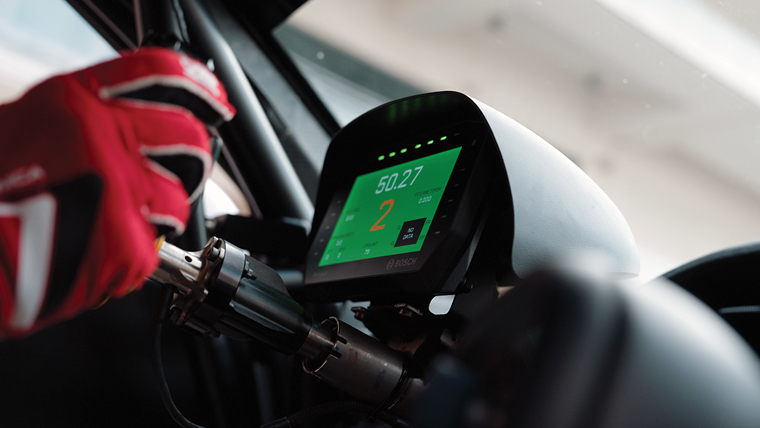
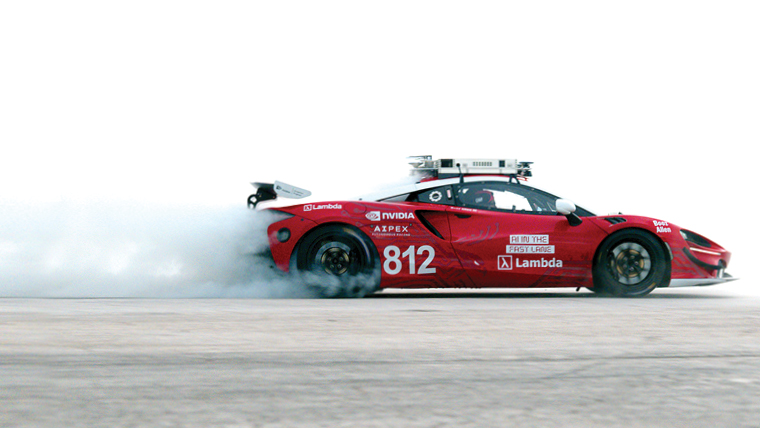
The demands placed on the cars and teams make the world of auto racing one of the most complex environments to navigate autonomously. It forces perception, planning, and control to work under extreme time pressure, dynamically changing conditions, and against intelligent opponents. That makes it an ideal testbed for physical AI: We can train on real and synthetic data, rehearse thousands of scenarios in high-fidelity simulation, then field improvements on track and feed telemetry back into the loop in an environment where we can readily track and assess performance.
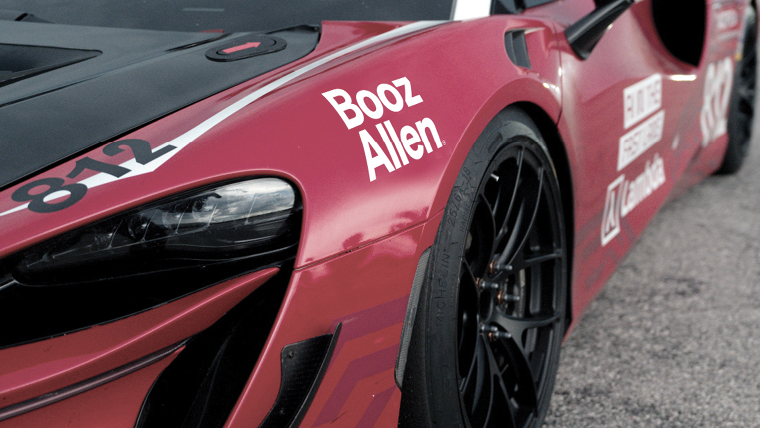
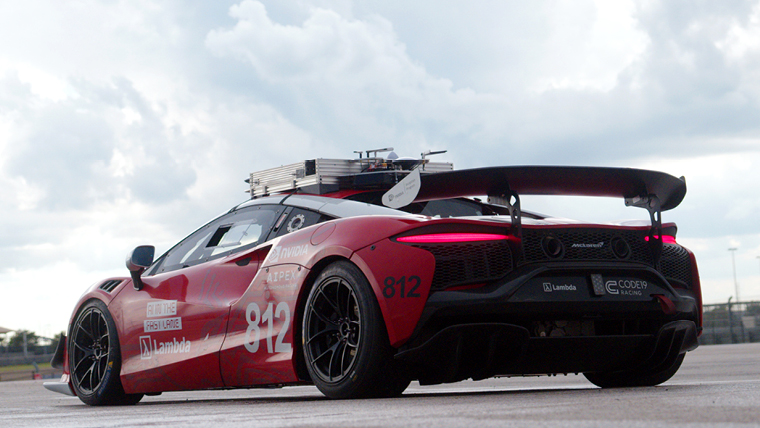
Booz Allen is working with Code19 Racing, the only U.S.-based team in the Abu Dhabi Autonomous Racing League (A2RL), which runs at the Yas Marina Circuit. The cars are Dallara EAV24 machines derived from Super Formula, built for autonomy with added sensors, actuators, and onboard compute. Working with Code19 offers a repeatable, measurable way we can prove behaviors before race day and then harden them after every session.
Racing highlights the “sim-to-real” challenge in concrete and complex ways. Consider tire temperature and grip. Cold tires slip. Track evolution (from temperature variations to rubbering and marbling) changes braking points and demands robust prediction under uncertainty. With integrated telemetry providing real-time feedback on these dynamics to the simulation, it can learn and better replicate the real-world driving experience. While the industry still has a long way to go to address the challenges within the “sim-to-real” gap, integrating simulated and real environments such as those that Code19 competes on provides an opportunity to explore tactics and techniques to close this gap.
A2RL has also staged human-versus-autonomy demonstrations at Yas Marina. So far, the human driver has prevailed, which is precisely why the race environment is valuable. It exposes the last eight seconds of performance gap that matter to mission risk and makes them measurable, fixable, and repeatable in the next turn of the flywheel.
Bottom line: High-speed autonomous racing combines a high-performance platform, a world-class circuit, and a rigorous physical AI loop to turn wicked hard operational problems into tractable engineering work—faster, safer, and with evidence leaders can trust.
Everything Changes When You Bring the Loop into the Real World
Consider three domains where physical AI can make a mission critical difference.
Expeditionary autonomy. Improving navigation in GPS-denied areas used to require a lot of complicated, time-consuming testing, often involving extensive simulations of jamming and spoofing. Traditional methods like hardware-in-the-loop and software-in-the-loop testing are important but slow.
Smart manufacturing. On high-mix production or assembly lines, the constraint is variability. A part is slightly out of tolerance, a surface is oily, a bin is half empty, lighting shifts, a tool wears. Robots that ace a demo can stall in production. With a physical AI loop, you turn computer-aided design (CAD), process plans, and line telemetry into a digital workcell. You train perception and force control across millions of synthetic picks, insertions, torques, and welds, then verify with instrumented floor trials. You release when coverage, first-pass yield, and cycle-time thresholds are met. Real faults and E-stops expand the scenario catalog so each shift gets steadier.
Smart environments. Borders, ports, bases, and substations rely on multi-sensor networks. Static rules often produce either alarm fatigue or missed signals. With a loop, you train fusion models on rare multi-sensor events. You test how a video anomaly, a vibration pattern, and a radio observation interact under different weather and lighting. You don’t need to wait for a real emergency to learn. When the model hands off to an autonomous platform or triggers a barrier, you already know how it will behave in conditions you would not accept as a live trial.
The theme across these examples is not novelty. It is confidence—at mission speed. You are not skipping safety; you are automating it.
“Motorsport is a crucible where really challenging engineering problems are solved but where failures are both public and unforgiving. Consequently, Motorsport is also the benchmark for closing the ‘sim-to-real’ gap. Our environment demands fast iteration, development, simulation, and physical validation, sometimes happening multiple times a day. By tightly integrating simulated and real-world race conditions, we can validate AI-driven systems at a pace that traditional development cycles simply can’t match.”
- O.G. Wells, Cofounder, Code19 Racing
The Loop Works for Testing as Well as Training
Across the federal space, policy is moving from “simulation as adjunct” to digital-first, evidence-based testing and evaluation (T&E). The Department of War set the tone with DoDI 5000.97 requiring new programs to incorporate digital engineering across the lifecycle and explicitly includes digital T&E. It calls for program managers to plan, resource, and govern models, digital twins, data, and artifacts as part of their acquisition strategy.
Other federal agencies are pointing the same way. NASA-STD-7009B (2024) is a mature government standard for model credibility, V&V, uncertainty quantification, documentation, and configuration control, widely referenced as a best practice.
The National Institute of Standards and Technology’s (NIST) AI Risk Management Framework (AI RMF 1.0) emphasizes T&E V&V throughout the AI lifecycle and encourages the use of controlled testbeds and synthetic data where appropriate. In regulated aviation, the FAA’s AC 20-115 recognizes model-based development and verification as an acceptable means of compliance, which in practice relies heavily on simulation to demonstrate software assurance. The Department of Homeland Security also signals the role of modeling and simulation in T&E planning and maintains centers of expertise to support operationally realistic evaluation.
Bottom line for programs: More advanced modeling and simulation can and should fulfill these needs, but only when it is planned from the start, tied to mission-relevant scenarios, and backed by V&V evidence. Digital engineering policy now expects programs to adhere to the following guidelines:
- Treat simulations, twins, and data as governed acquisition artifacts.
- Use distributed and hybrid testing to combine sim, software-in-the-loop, hardware-in-the-loop, and limited range events.
- Present auditable coverage and performance metrics to decision authorities.
That is the policy foundation for a physical AI “digital proving ground” that reduces risk, speeds learning, and supports continuous accreditation.
Test and Evaluation: Turn the Loop into a Digital Proving Ground
Physical AI does more than teach systems to handle edge cases. It also gives programs a rigorous T&E engine that replicates real-world performance in software, then verifies and validates it before deployment.
You define a mission-relevant scenario catalog, tie each scenario to a risk budget and requirement, and rehearse thousands of controlled variations across weather, lighting, traffic, sensor faults, and adversarial behaviors. The same builds then run through software-in-the-loop, hardware-in-the-loop, and limited range trials, creating reproducible evidence that evaluators and safety authorities can trust. Leaders get an auditable package, not anecdotes: scenario coverage and pass rates, confidence and calibration curves, latency and stability margins, disengagement and safe-state entry metrics, and a traceable safety case that blends simulation with instrumented field data. Because scenarios, assets, and telemetry schemas are standardized, you can replay the identical test battery across multiple engines and test sites, compare apples to apples, and keep regression testing continuous after deployment.
The result is faster developmental testing (DT) and operational testing (OT), clearer readiness decisions, and a path to continuous accreditation where each release ships when coverage and risk thresholds are met, not when the next test window opens.
Why Now? Hardware and Software Advances Create New Opportunities
Today’s robotics, autonomous systems, and smart infrastructure are powered by tech stacks that sense, understand, decide, and act, often inside a smart environment that is instrumented with connected sensors and compute:
- Perception and Localization. Cameras, LiDAR, radar, IMUs, RF signals, and maps place the system in context.
- Decision and Control. Planners and policies balance mission goals, constraints, and safety while coordinating across agents.
- Connectivity and Compute. Edge processing supports low-latency reflexes; cloud and high-performance computing (HPC) support training, analytics, and fleet learning.
But this stack is poised for disruption as ongoing advances in both inputs, like camera and sensors, and outputs, including actuators and propulsion systems, enable higher fidelity, more agile performance. Furthermore, these systems are increasingly expected to collaborate with other autonomous systems. For these systems to operate at their full potential, more decisive reasoning is needed, which physical AI can foster.
Physical AI: Ship Faster, Safer, with Evidence
Even with solid building blocks, programs still struggle to generalize to the long tail of edge cases, to produce auditable evidence of readiness, to maintain data integrity and provenance, and to remain resilient when networks degrade or adversaries intervene. This is where physical AI shines. Physical AI is not just a tool. It is an operating model that teaches, tests, and proves behaviors before fielding, then keeps improving them after. The payoff is a repeatable, validated process cycle that automates both improvements and safety testing.
Treat the loop as a digital proving ground for testing and evaluation. Define a mission-relevant scenario catalog, rehearse thousands of controlled variations in high-fidelity environments, and get reproducible evidence your evaluators can trust. Use the same scenarios for software-in-the-loop, hardware-in-the-loop, limited range trials, and post-deployment regression so each release ships on demonstrated coverage and risk thresholds, not on calendar windows.
To stay agile as the ecosystem evolves, own the interfaces and artifacts: the scenario catalog, policy bundle, telemetry schema, and evaluation reports. This preserves flexibility across engines and vendors while accelerating accreditation and scale from pilot to program to portfolio.
New edition | v5. summer 2026
Explore the New Velocity

cover story
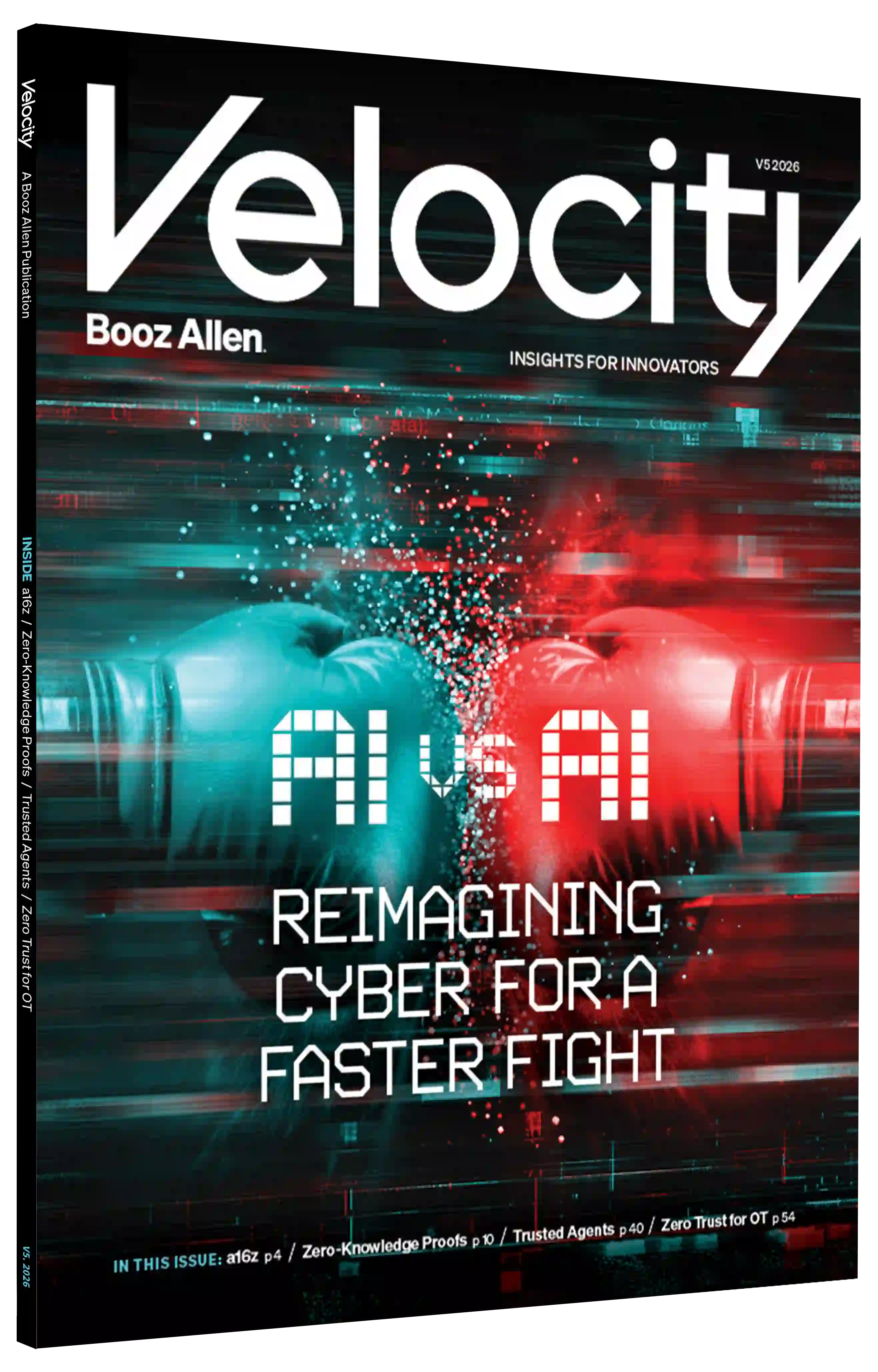
Reimagining Cyber for a Faster Fight
Securing enterprises against AI threats requires disrupting operating models, enriching detection, and strengthening resilience—because attacks now unfold in minutes, not days.
tech spotlight
How Can You Trust Agentic AI? Start with Engineering
Why trust must be designed, governed, and validated—not assumed.
mission spotlight
Infrastructure Under Attack: The Zero Trust Imperative
Cybersecurity must go beyond compliance to defeat new threats.
in conversation
Infrastructure to Impact with Raghu Raghuram
An interview with Raghu Raghuram, managing partner at a16z.
emerging trends
The Math that Makes Technology Trustworthy
Formal methods and automated reasoning are reshaping software and AI security.
lessons from the edge
Resilience Tops Perfection: Desiging for Failure Wins
Resilience doesn't come from preventing failure, it comes from surviving it well.
tech watch
Don't Take My Word For It: Zero-Knowledge Proofs
Trusting more (but revealing less) with zero-knowledge proofs for government.

in conversation
Infrastructure to Impact with Raghu Raghuram
An interview with Raghu Raghuram, managing partner at a16z.
emerging trends
The Math that Makes Technology Trustworthy
Formal methods and automated reasoning are reshaping software and AI security.
lessons from the edge
Resilience Tops Perfection: Desiging for Failure Wins
Resilience doesn't come from preventing failure, it comes from surviving it well.
tech watch
Don't Take My Word For It
Trusting more (but revealing less) with zero-knowledge proofs for government.
New edition | v5. summer 2026
Explore the New Velocity

cover story
Reimagining Cyber for a Faster Fight
Learn how CISOs are rebuilding to keep pace with AI-powered attacks.

tech spotlight
How Can You Trust Agentic AI? Start with Engineering
Why trust must be designed, governed, and validated—not assumed.
mission spotlight
Infrastructure Under Attack: The Zero Trust Imperative
Cybersecurity must go beyond compliance to defeat new threats.
in conversation
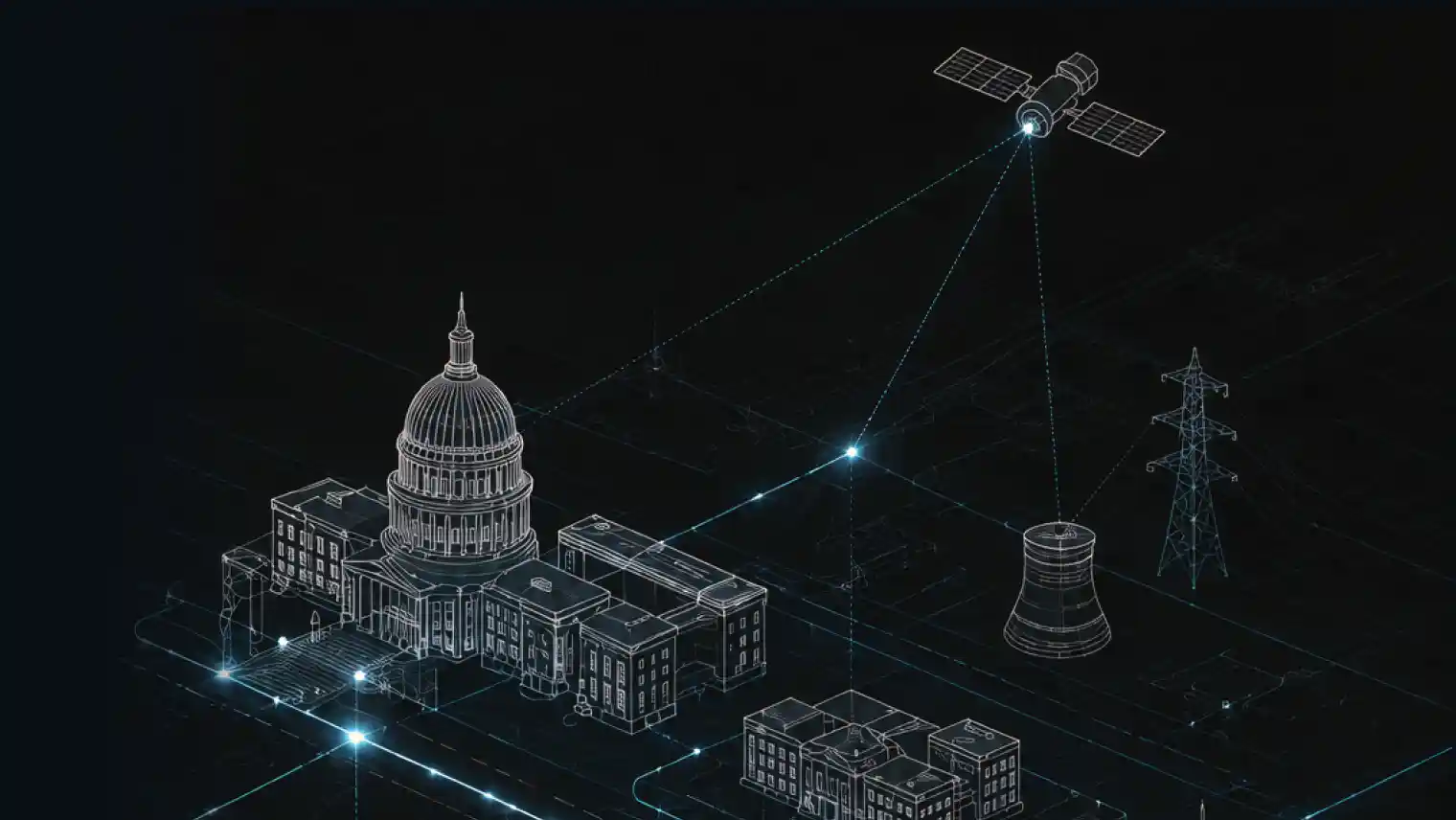
Infrastructure to Impact with Raghu Raghuram
An interview with Raghu Raghuram, managing partner at a16z.
emerging trends
The Math that Makes Technology Trustworthy
Formal methods and automated reasoning are reshaping software and AI security.
lessons from the edge
Resilience Tops Perfection: Designing for Failure Wins
Resilience doesn't come from preventing failure, it comes from surviving it well.

tech watch
Don't Take My Word For It: Zero-Knowledge Proofs
Trusting more (but revealing less) with zero-knowledge proofs for government.
