
How We Built a Better Innovation Factory
Haluk Saker shares how we built a trusted cloud platform
By Haluk Saker
Recent directives have made it clear: Government buyers want solutions that are ready now. Easier said than done.
Developing software in secure environments is slow work. Weeks are lost provisioning the right cloud accounts, months disappear while teams stitch together security controls, and help desk tickets pile up—just to get developers up and running. Security and compliance layers exist for good reason, but they also create speed bumps—and sometimes land mines—when speed matters most.
Look at how DevOps support teams spend their time, and the problem becomes obvious: they’re buried in tickets. Most of their energy goes to triaging requests instead of improving the platform.
The truth is, developers don’t need another blank slate to innovate. They need the freedom to focus on solving mission problems protected by guardrails they trust. To meet mission requirements, we need people to have an idea in the morning and a secure, production-ready proof of concept by the afternoon.
Speed Read
The platform is the product. Once we treated the platform like a core product—with its own roadmap, support team, and governance—we gained the discipline to keep it secure, modern, and optimized for every project.
Quality isn’t negotiable—it’s engineered. Moving fast doesn’t mean cutting corners. Our marketplace model ensures every contribution is security-reviewed and compliance-tested before it’s available. That lets developers move quickly without sacrificing any rigor.
The platform's marketplace model fosters collaboration across teams, enabling code reuse and creating an innovation flywheel, which accelerates the delivery of mission-critical solutions like the AI-first Vellox Reverser.
Breaking the Innovation Bottleneck
Like many companies, Booz Allen has embraced a DevSecOps approach for years. I even co-wrote the Enterprise DevOps Playbook back in 2016. We built centers of excellence across the company that improved quality and productivity. But we still struggled to move innovations seamlessly and readily into client production environments at the accelerated pace we wanted.
We tried being “cloud-agnostic.” That was impractical. Government projects struggled to capitalize on the native features of a single cloud—let alone multiple environments—and ended up with the worst of all worlds. We tried DevSecOps factories. They delivered quick wins, but only for one team or one program and couldn’t be reused. We tried finding “unicorn engineers” who knew cloud, security, and DevOps end to end. That wasn’t sustainable or economical.
We built dozens of effective tools that solved specific problems. But getting them to work together often took more effort than it saved. We needed to scale both horizontally across the company and vertically across delivery.
Finally, we realized: more tools weren’t the answer. Sometimes you don’t need better tools—you need a better environment.
A New Platform for Innovation
We stopped treating the platform like a backdrop and started treating it like a product.
The vision was simple. We imagined a pre-vetted environment developers could step into: controls pre- mapped, tools vetted, pathways cleared. We wanted pre- loaded templates and reusable modules for authorization, data handling, and monitoring to eliminate redundant work. We imagined that developers could stop submitting tickets for setup and instead start coding immediately.
Nobody thought it would work.
Every team had its own portals, contracts, and silos. They were tied to their own ways of doing things. People said, “One size doesn’t fit all.”
And they were right, but we weren’t building a one-size tool. We were building one framework. One that could support many sizes—in our case, defense, national security, civil, and commercial—while still inheriting the same foundation.
Instead of focusing on small differences buried deep in requirements, we designed our platform around shared expectations like our security posture. We all asked, “What does every developer need? And how can we get it to them faster?”
What Makes Our Platform Different
Compliant by design
Our platform is designed in accordance with the NIST 800-53, 800-171 and other security control families and accredited standards. Security and compliance are built in from the start, so developers can generate code, troubleshoot, and deploy without worrying about compliance.
Built for developers
Instead of a blank cloud account, developers step into a curated workbench with pre-vetted tools, available through a self-service portal. If a developer needs to open a help desk ticket to get a tool, we consider it a failure. Their time should be spent innovating.
Reusable
Pre-approved golden paths, reusable services, and shared components cut costs and time from every project. Monitoring, alerting, and scaling come standard. Rapid prototyping blueprints let teams spin up experiments quickly—without compromising compliance, even in highly regulated production environments.
AI-enabled
AI works two ways in our trusted platform: developers benefit from AI-assisted coding, pre-configured CI/CD pipelines, and faster troubleshooting. At the same time, embedded AI makes the platform itself smarter and more efficient with every use.
Self-Service Speeds Innovation
Shared platforms don’t happen by decree. We had to build bridges across silos and give people a framework to contribute. For us, that meant creating a marketplace model, like an internal app store. Teams could grab what they needed—or add their own modules—as long as they passed our compliance standards.
For developers, the change was night and day. Onboarding that once took three weeks can now be done in 70 minutes. Developers can be coding in a new, fully stocked environment faster than you can bake a loaf of bread. And they can focus on solving mission problems—not configuring buckets or rebuilding the basics.
There are no shortcuts. Compliance is built in, with documentation that makes integration into client environments smoother, safer, and faster. We’re talking about production deployments in days, not months, and with far lower risk.
This isn’t just theory. We proved it with Vellox Reverser™, an AI-first product to reverse-engineer malware. Our timeline from concept to production was about six months—with no authority-to-operate delay.
Because the Vellox Reverser product’s components—authorization modules, data-handling blueprints, and monitoring frameworks—now live inside the platform, they can be reused by other teams. Its success didn’t just deliver one product; it accelerated the next wave of innovation.
For agencies under pressure to deliver more capabilities, more quickly, and with fewer resources, this approach changes the equation. It clears compliance and infrastructure bottlenecks so breakthrough ideas can move at mission speed. When new AI tools and dev accelerators are being released weekly, waiting six months to start writing code isn’t an option.
Now we can build as fast as clients and developers can dream.
Looking Back, Looking Forward
Giving up some individual control was uncomfortable at first, but it unlocked a much richer and more sustainable platform. Solutions don’t live and die within a single project, so breakthroughs stop being one-offs—they become repeatable.
Every component built in our environment is available in our marketplace for the next project, creating an innovation flywheel. The more we build, the faster innovation spins.
Sound too good to be true? It’s not. We used this approach to build and launch Vellox Reverser, an AI-first tool that reverse-engineers malware. And the results speak for themselves:
- Deployed in 6 months – From idea to mission-ready deployment
- Zero authority-to-operate delays – Continuous compliance eliminated lead time
- Accelerated reuse – Marketplace makes code reuse real
- Endless possibilities – Every innovation seeds the next
Meet the Author
Haluk Saker has spent over three decades modernizing digital systems for government clients. He led the redesign of Recreation.gov, transforming it into one of the federal government’s most-used platforms, and now heads innovation efforts at Booz Allen.
The author wishes to recognize Shums Hoda, Steven Terrana, Stephen Mao, Matt Lisco, Andrew Smallwood, Martin Folkoff, Madhu Ravi, Lizzie Salita, Goran Osim, and Regina Trapilo— whose contributions were invaluable to this effort.

New edition | v5. summer 2026
Explore the New Velocity

cover story
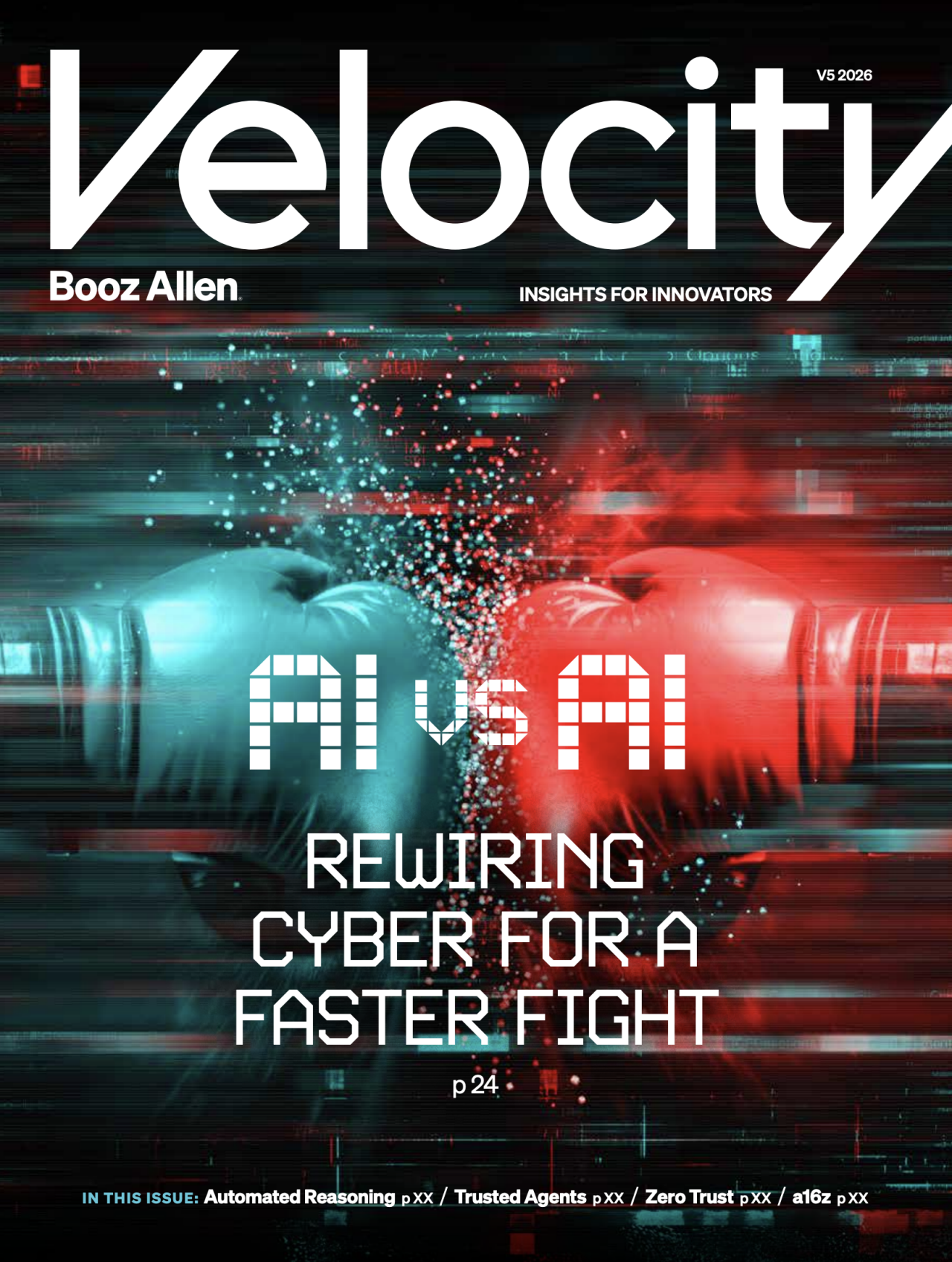
Reimagining Cyber for a Faster Fight
Securing enterprises against AI threats requires disrupting operating models, enriching detection, and strengthening resilience—because attacks now unfold in minutes, not days.
tech spotlight
How Can You Trust Agentic AI? Start with Engineering
Why trust must be designed, governed, and validated—not assumed.
mission spotlight
Infrastructure Under Attack: The Zero Trust Imperative
Cybersecurity must go beyond compliance to defeat new threats.
in conversation
Infrastructure to Impact with Raghu Raghuram
An interview with Raghu Raghuram, managing partner at a16z.
emerging trends
The Math that Makes Technology Trustworthy
Formal methods and automated reasoning are reshaping software and AI security.
lessons from the edge
Resilience Tops Perfection: Desiging for Failure Wins
Resilience doesn't come from preventing failure, it comes from surviving it well.
tech watch
Don't Take My Word For It: Zero-Knowledge Proofs
Trusting more (but revealing less) with zero-knowledge proofs for government.
in conversation
Infrastructure to Impact with Raghu Raghuram
An interview with Raghu Raghuram, managing partner at a16z.
emerging trends
The Math that Makes Technology Trustworthy
Formal methods and automated reasoning are reshaping software and AI security.
lessons from the edge
Resilience Tops Perfection: Desiging for Failure Wins
Resilience doesn't come from preventing failure, it comes from surviving it well.
tech watch
Don't Take My Word For It
Trusting more (but revealing less) with zero-knowledge proofs for government.
New edition | v5. summer 2026
Explore the New Velocity

cover story
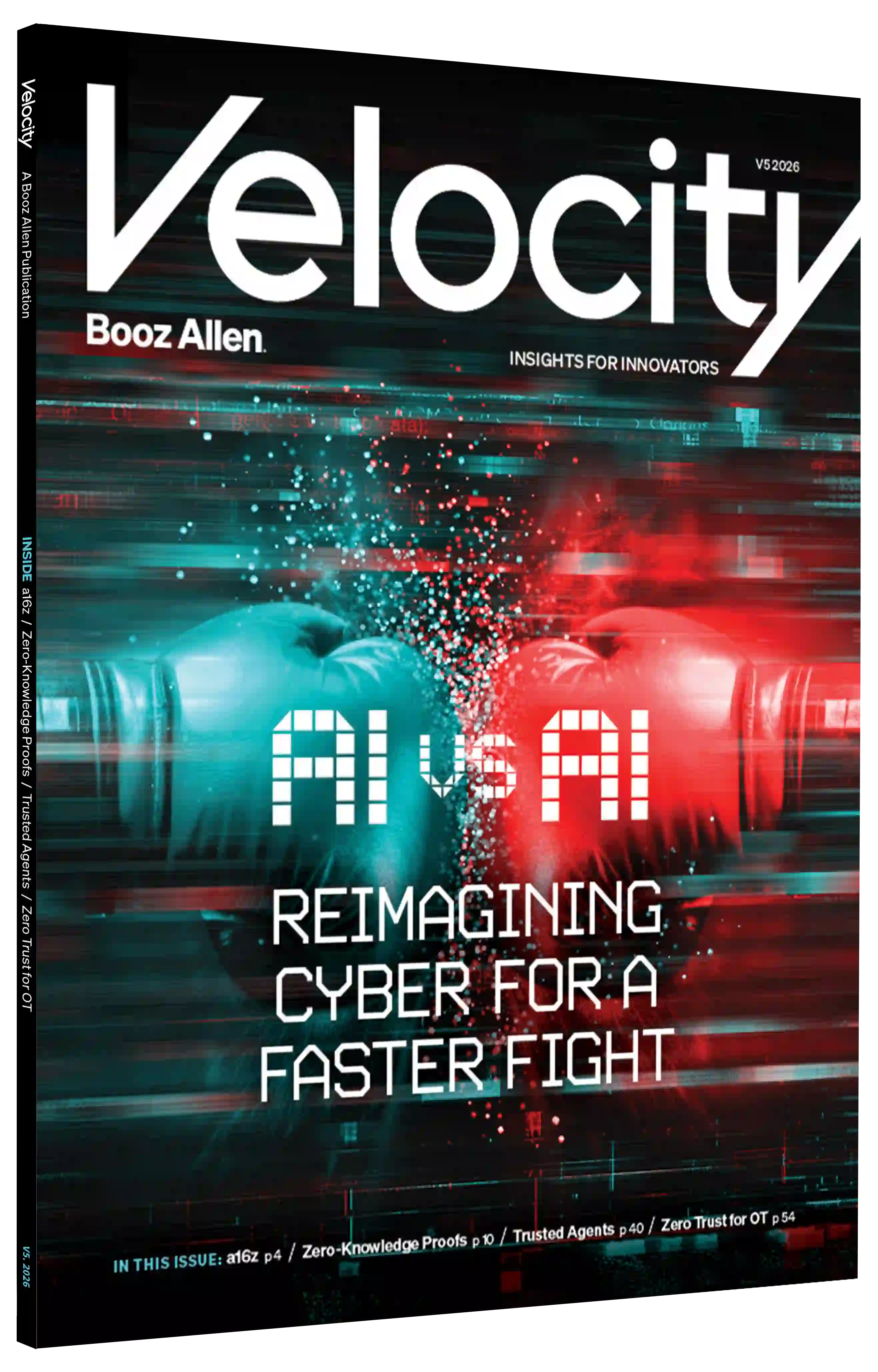
Reimagining Cyber for a Faster Fight
Learn how CISOs are rebuilding to keep pace with AI-powered attacks.

tech spotlight
How Can You Trust Agentic AI? Start with Engineering
Why trust must be designed, governed, and validated—not assumed.

mission spotlight
Infrastructure Under Attack: The Zero Trust Imperative
Cybersecurity must go beyond compliance to defeat new threats.

in conversation
Infrastructure to Impact with Raghu Raghuram
An interview with Raghu Raghuram, managing partner at a16z.

emerging trends
The Math that Makes Technology Trustworthy
Formal methods and automated reasoning are reshaping software and AI security.

lessons from the edge
Resilience Tops Perfection: Designing for Failure Wins
Resilience doesn't come from preventing failure, it comes from surviving it well.

tech watch
Don't Take My Word For It: Zero-Knowledge Proofs
Trusting more (but revealing less) with zero-knowledge proofs for government.
