Let’s envision a busy airport where unauthorized drone activity and unauthorized users of RF spectrum can pose serious risks to flight safety and network performance. Booz Allen’s R.AI.DIO AI-enabled spectrum sensing system can detect and classify this in-band interference, even if it is overlapping normal commercial and aviation transmissions. Critical capabilities such as video feeds or ISACs can be degraded by jammers or unauthorized users' interference. R.AI.DIO Spectrum Sensing is a GPU-enabled, distributed application or dApp that continuously monitors the RF environment, allowing mobile network operators and private 5G providers to respond to threats in real-time by alerting security teams or by initiating automated mitigations like physical resource block, or PRB, blanking to preserve network integrity. Here we have a laptop that is using a software-defined radio, SDR, to transmit signals which interfere with the 5G UE uplink inside the shielded box or test chamber. In this setup, one or more users send uplink data via a UE, and an SDR creates in-band interference, which R.AI.DIO senses. When an uplink message transmission fails, R.AI.DIO then detects whether interference is present, and the output is shared with the spectrum sensing capability. Next, we will look at the R.AI.DIO dApp view. This visualization helps us to quickly identify and address any issues. The R.AI.DIO AI model provides details about an interfering signal, such as the interfering waveform type, percentage confidence level for that prediction, and more. This view indicates interference detection. You will see a grid of network resources where green signifies normal operation, gray is unused spectrum, and orange, red, or purple indicates the presence of a jammer. This visual representation helps us quickly identify and address any issues. When a user activates the jammer by selecting a waveform type and transmit duration, a command is sent to an SDR connected to the RF test chamber with the radio unit and UE inside to inject interference into the spectrum. When the interference is detected by the R.AI.DIO spectrum sensing application, the time and frequency cells on the plot will be color coded orange, red, or purple, depending on the type of interference detected. This allows network operators to quickly determine if degraded network performance is due to unauthorized users, jammers, or normal conditions. Here we can see the R.AI.DIO spectrum sensing application correctly identifying the different types of interference that were transmitted at 3.75GHz, with DSSS in orange, QPSK in red, and 64QAM in purple. The R.AI.DIO spectrum sensing application also has the ability to visualize the real-time fronthaul IQ data from NVIDIA's aerial framework, which is used by the dApp to identify interference. The top plots show the spectrogram view of data at each antenna. The middle plots show the time series IQ data. In the bottom, plots show the PSD, or power spectral density, where you can see the interfering signal in the center of the spectrum, which is stronger than the 5G uplink. R.AI.DIO enables mobile network operators to understand if users are experiencing degraded performance on a network due to normal conditions, or if malicious actors are causing degraded network performance so that MNOs can appropriately respond.

NextG Technologies
5G today. AI-RAN gateway to 6G.
In the modern theater of operations, connectivity is a weapon system. Booz Allen provides the digital backbone for the multi-domain battlespace, delivering a breakthrough AI Radio Access Network (AI-RAN) architecture designed for the uncompromising demands of national defense.
We bridge the gap between high-capacity 5G mission-critical networks and the autonomous future of 6G intelligence. By embedding AI directly into the radio access network at the tactical edge, we ensure that data isn’t just transmitted—it is processed, protected, and prioritized where the mission happens.
What Is AI-RAN?
AI-RAN takes wireless connectivity to the next level. Instead of traditional networks that rely on static rules and manual tuning, AI-RAN brings artificial intelligence directly into the radio access network—the part of mobile infrastructure that connects devices to the cloud—at the edge. This enables the network to learn, adapt, and optimize itself in real time.
By embedding AI at the edge, AI-RAN:
- Continuously analyzes radio conditions, and user demand.
- Dynamically allocates spectrum.
- Balances load.
- Reduces energy consumption.
- Improves performance where it matters most—latency, reliability, and user experience.
The result is a smarter, more efficient network that scales effortlessly to meet the demands of tomorrow.
The Future of Wireless and Why It Matters
AI-RAN and the Race to 6G
Discover how AI-RAN technology optimizes network performance and serves as the foundation for the future 6G stack.
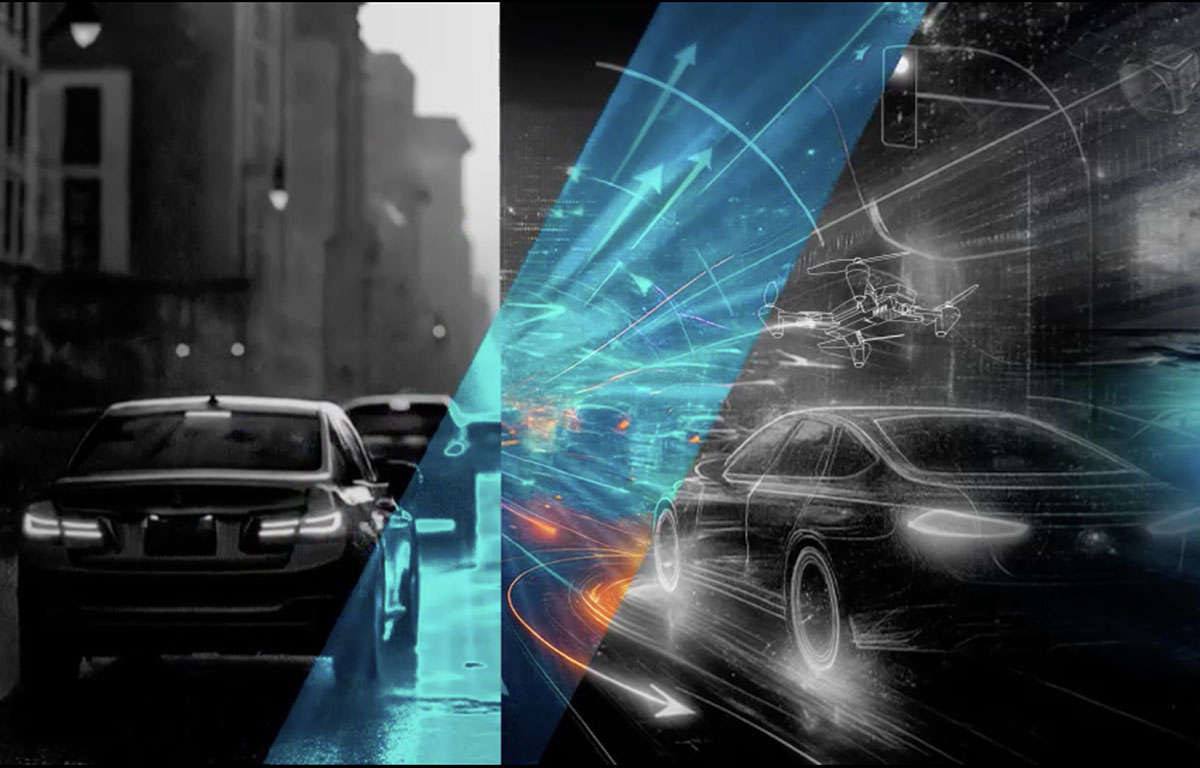

AI-WIN Project Paves the Way to 6G
Announced in March 2025, AI-WIN brings together Booz Allen, NVIDIA, T-Mobile, MITRE, Cisco, and ODC to develop an AI-native wireless network stack for 6G on the NVIDIA AI Aerial platform. Booz Allen is developing AI-RAN algorithms as well as approaches to secure the AI-native 6G wireless platform.
RAN, Reinvented: Our AI-RAN Solution
Booz Allen’s AI-RAN Stack advances wireless networks by combining secure, scalable infrastructure, software-defined wireless connectivity, and advanced AI applications ecosystem at the edge. Drawing from development work within the AI-Wireless Network (AI-WIN) initiative, our solution equips organizations to meet today’s mission-critical demands while positioning them for tomorrow.
R.AI.DIO® Spectrum Sensing
See the Booz Allen R.AI.DIO® AI-enabled spectrum sensing in action as it detects and classifies in-band interference in real time at a busy airport, ensuring flight safety and network performance. R.AI.DIO® provides intelligent and adaptive monitoring to maintain seamless communication and efficient spectrum utilization.
Vision AI Multimodal ISAC Sensing
See how Vision AI Multimodal ISAC transforms safety by detecting and classifying pedestrians in real time. This AI-enabled system combines Vision AI with ISAC to deliver intelligent, adaptive monitoring for safer, more efficient intersections.
Imagine we are at an intersection we want to monitor for transportation and pedestrian safety. We will use combined vision and integrated sensing and communications, or ISAC capabilities to sense pedestrian traffic in order to meet this need. Booz Allen's Vision AI is a platform for edge inference that can ingest various data types such as imagery, video, and radio frequency signals data. To run AI on RAN, we are implementing vision AI output for detection and classification of pedestrians. For this demo, NVIDIA is implementing their ISAC capability. This system showcases how existing wireless signals can be used to sense and understand the environment, utilizing available 5G radio waves. Camera feeds provide excellent sensing in clear, non-obstructed conditions. However, the ISAC sensing capability provides additional information where vision is weaker, such as at night or conditions with low visibility like rain, snow, and physical obstructions. ISAC additionally provides information about the detected pedestrians, such as distance and location. For the setup, we have an RU acting as the RF receiver, along with a camera positioned at the same location as the RU. We also use a commercial UE for uplink transmission. With this setup, we are able to sense a pedestrian through two modes, Vision and ISAC, and view the fused results overlaid. As we switch to conditions with reduced visibility the camera no longer detects the pedestrian, while ISAC continues to detect it. Having multi-modal information produces stronger and more accurate outcomes. By bringing these capabilities to our AI-RAN stack Booz Allen can improve sensing capabilities at the edge, meeting the challenge to use our resources effectively in complex environments.
Maintaining continuous awareness of the environment is critical for many industries such as public safety and emergency response. Visible light cameras, also known as electro optical cameras, are valuable sensing tools. But just like human eyes on their own, they have limitations – especially in low visibility conditions such as fog, obstructions, or darkness. The answer to this is sensor fusion, combining multiple data types to enhance certainty. Utilizing multimodal information produces stronger outcomes compared to relying on a single sensing modality. The integration of vision, IR, and ISAC capabilities enhances overall scene comprehension, as each modality compensates for the other's limitations. Deploying multiple cameras expands coverage and reduces blind spots while integrating infrared, or IR, and integrated sensing and communications, or ISAC, significantly enhances detection confidence when visibility is poor. Consider a scenario where emergency responders need to perform search and rescue in an environment with poor lighting conditions at night and partially hidden victims. By performing sensor fusion and combining multiple electro optical, or EO, cameras with IR and ISAC sensors, the system can reliably detect and track the individual, even in challenging conditions. Booz Allen's Vision AI platform provides artificial intelligence model training and deployment that ingests various data types, or modalities, such as imagery, video, and radio frequency signals data. In this scenario, Vision AI brings AI to RAN through the use of these trained machine learning models for detection and classification of people for search and rescue. Here, EO and IR data are streamed with results displayed in real time. Edge fusion builds on our existing ISAC capabilities by introducing IR for resiliency. A combined spatial view allows for rapid user understanding of the scene. Here we can sense a person with multiple modes, with fused results displayed as a unified detection. Additionally, sensor fusion combines information from multiple modalities, increasing confidence and providing reliable detections even in low visibility or complex conditions. As we switch to darkened conditions where vision alone no longer produces accurate detections, we see we are still able to detect the person due to the added resiliency of IR. The integration of multiple data modalities such as vision, IR, ISAC, and others showcases how sensor fusion can transform response efforts, ensuring that even in challenging conditions, critical missions are executed with confidence.
Vision AI Edge Fusion
See Vision AI Edge Fusion enhance search and rescue with real-time detection and tracking in low visibility. Combining EO cameras, IR sensors, and ISAC over 5G, it delivers unified awareness, depth estimation, and adaptive monitoring in complex environments.
Use Cases
- Edge computing at the tactical edge
- Autonomous drones
- Smart cities and intelligent transportation networks
- Pedestrian safety
- Border security and critical infrastructure monitoring
- Smart manufacturing and warehousing
Watch how Booz Allen’s AI-RAN Stack connects a quadruped robot in a simulated gas leak scenario, enabling real-time operation and computer vision analysis to assess conditions before first responders enter, reducing risk and improving response precision.
A suspected flammable gas leak has triggered the evacuation of an office building. With sensors offline, first responders must find a way to avoid blind entry while confirming 100% evacuation. To reduce human risk, Wilco will verify that the building is empty. Wilco enters the hot zone while streaming live video and sensor data over an AI-RAN link. The AI-RAN stack provides connectivity to Wilco to enable remote teleoperation and hosts computer vision models that provide decision support. If a person is confirmed inside, responders will perform a targeted entry using proper controls. The result: a faster, safer decision-making process, allowing rescue teams to enter with purpose, not guesswork. Learn more at boozallen.com/NextG
Smarter Networks. Stronger Outcomes.
Booz Allen’s AI Native Wireless Innovation Center
Our AI Native Wireless Innovation Center provides the environments required to test new technologies, use cases, and cybersecurity solutions. Our facilities include the following advanced labs:
AI-RAN Lab
By combining AI and Private 5G technology, we are advancing radio access network development. Our AI-RAN Lab supports reliable product baseline configuration, accelerates prototyping, enhances performance tuning, and strengthens resilience through intelligent anomaly detection. Robust observability and automated test orchestration ensure faster, reliable RAN product launches.
5G Carrier-Grade Lab
5G standalone (SA) and non-standalone (NSA) configurations enable testing of 5G in both carrier and enterprise configurations with backward-compatible 4G core features. Includes a multiaccess edge compute (MEC) solution; network slicing to provide segregated, cloud-native network functions; and a radio access network capable of broadcasting at multiple bands, including mmWave (28 GHz) and mid-band (2.4 GHz and 3.5 GHz).
Multivendor Open-RAN Lab
Leveraging funding from the National Telecommunications and Information Administration’s Public Wireless Supply Chain Innovation Fund, our Open-RAN lab is used to conduct security research on multivendor, Open-RAN systems, helping to advance the industry’s understanding of sophisticated threats and the conduct of security testing associated with these new types of 5G networks.
Radio Frequency (RF) Engineering Lab
Among other capabilities, our RF systems laboratory supports RF spectrum monitoring, coverage measurements, and antenna and transmission line testing and validation. Our lab includes several RF analysis tools, including calibrated measurement receivers, test transmitters and antennas, portable network analysis equipment, and test equipment to test expeditionary operation of legacy or advanced RF communications systems. We incorporate advanced electromagnetic (EM) modeling and simulation tools in our lab to provide detailed computational electromagnetic modeling and simulation of antennas and their interaction with their mounting platforms and environment.
Featured Content

Shaping U.S. Leadership in 6G and Beyond
AI-WIN leaders discuss role in advancing U.S. innovation and competitiveness with secure AI-RAN platforms, paving the way for future AI-native 6G systems.
Transforming U.S. Navy with 5G—Booz Allen, Ericsson, and Nokia
Booz Allen, Ericsson, and Nokia deployed a 5G lab and test environment to create ship-wide and pier-to-ship communications for the U.S. Navy at Naval Station Norfolk.

Building America’s AI-Native 6G: Architecture, Timelines, and Ecosystem Innovations
Building on the AI-WIN initiative and the first all‑American AI‑native wireless stack announced in 2025, this session focuses on moving from concepts and demos to deployable systems; featuring CTO Bill Vass.
NextG Insights


In the News
- Booz Allen Advances AI-powered NextG for America | Booz Allen Hamilton Inc.
- Linux Foundation Announces OCUDU Ecosystem Foundation to Accelerate Open Source AI-RAN Innovation | The Linux Foundation
- NVIDIA and Global Telecom Leaders Commit to Build 6G on Open and Secure AI-Native Platforms | NVIDIA
- Booz Allen Wins $99M Wireless Network Contract With Navy | Booz Allen Hamilton Inc.
