Accelerating AI-Powered 6G Spectrum Sensing

Advanced spectrum detection and sensing
In today’s rapidly evolving technological landscape, government agencies and commercial mobile network operators face increasing challenges in maintaining the integrity and efficiency of their communication systems. A critical need of modern and secure networks is detecting and characterizing interference within their licensed spectrum. This article outlines an innovative software-defined, AI/ML-based embedded approach interoperable with existing network deployments while providing network operators with enhanced information on spectrum health and system performance.
Identifying and Characterizing Interference
Government agencies and commercial mobile network operators rely on robust communication systems to ensure their operations and business functions run smoothly. Unlicensed and rogue signal emitters operating without authorization in licensed spectrum can degrade or deny mobile network capacity and coverage. A comprehensive process to detect and characterize interference is essential for maintaining optimal performance. Automatically identifying anomalies, such as dropped phone calls or degraded network connections, and alerting agencies or operators to the issue is now possible through AI/ML-based solutions.
AI/ML Spectrum Sensing for Interference Detection
Spectrum sensing plays a foundational role to next-generation mobile networks, enabling operators to detect, analyze, and manage the electromagnetic environment with precision. Utilizing advanced AI/ML-based applications, Booz Allen offers an innovative software-defined solution that identifies interference signatures for further mitigation actions by the base station. Unlike traditional methods that require external sensing equipment, our approach blends seamlessly with existing network infrastructure, providing an efficient and reliable way to maintain optimal spectrum health.
Booz Allen’s collaboration with NVIDIA, piloting sensing to detect and estimate interferers’ geolocation, is part of a broader effort driving industry momentum through the NVIDIA-led AI WIN project. Announced in March 2025, AI WIN brings together Booz Allen, NVIDIA, T-Mobile, MITRE, Cisco, and ODC to develop an AI-native wireless network stack for 6G on the NVIDIA AI Aerial platform. NVIDIA Aerial Framework makes physical Layer 1 radio access network (RAN) data available for processing by distributed AI/ML applications (dApps) within the RAN, such as the Booz Allen R.AI.DIO® signal processing kit. The R.AI.DIO signal processing application monitors the spectrum for unlicensed interferers using advanced algorithms tightly embedded with trained ML models, and helps track and mitigate in-band interferers that may degrade mobile network operator (MNO) performance with unauthorized transmissions in licensed spectrum. Through AI WIN, this collaboration advances AI-native platform and software-defined architectures to improve services for potentially billions of users.
R.AI.DIO® Signal Processing Kit
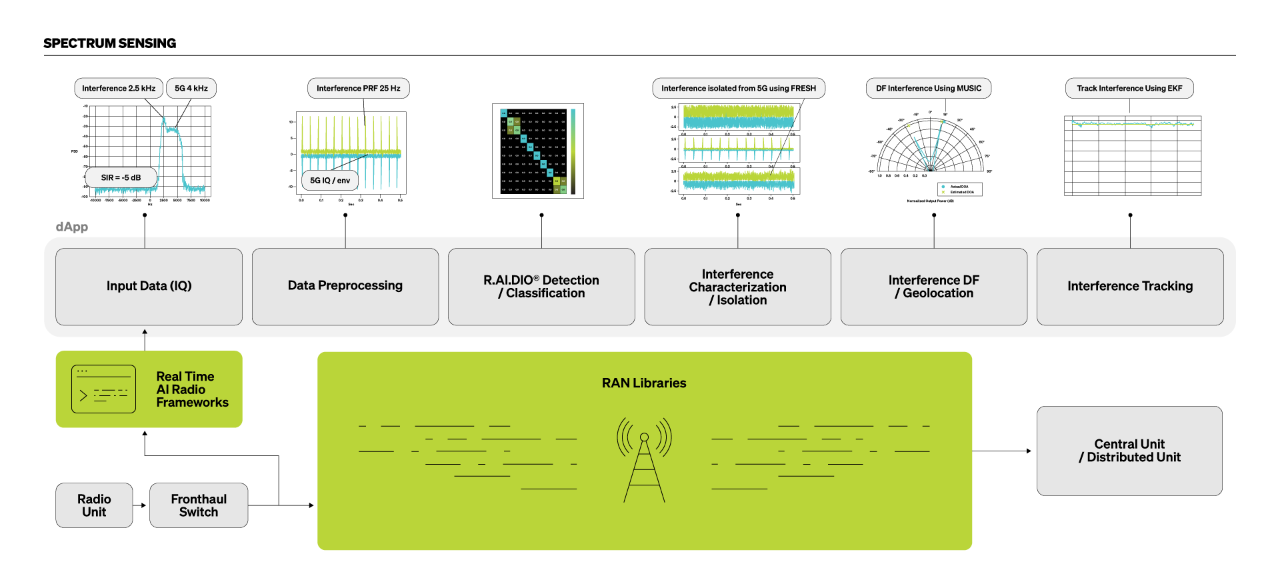
The R.AI.DIO® signal processing application leverages IQ sample data output from a RAN Radio Unit (RU) that is passed through NVIDIA’s AI Aerial platform. The data is then fed into R.AI.DIO® ML models to identify 5G signals and potential interference. If interference is detected, the signal is isolated from 5G signals by utilizing a filter to remove known frequencies, leaving the interfering signal for further characterization. This process includes isolating the interference from the underlying 5G signal using FRESH (frequency shift filtering), fast independent component analysis (FastICA), or another suitable filtering method. The direction-finding algorithm MUSIC (multiple signal classification) is used to determine the direction of the interference.
Finally, an extended Kalman filter (EKF) is employed to track the location of the interfering signal. This technique smooths out measurements, providing a reliable location estimate for the source of the interference. Combining outputs from multiple radio units further enhances geolocation accuracy.
Achieving Optimal Spectrum Health
The ultimate goal is to identify interfering signals, determine their general location, and understand their patterns to alert MNOs of their presence. By isolating and recording the interfering signal, specialized detectors can be built for future identification. This capability is crucial for detecting non-cooperative transmissions within 5G channels and ensuring the integrity of government communication systems.
Value of dApps Framework
The adoption of distributed applications (dApps), a part of NVIDIA Aerial Framework, offers substantial advantages for the federal government and mobile network operators. The dApps framework enables seamless integration and scalability with real-time and low-level RAN data through application programming interfaces (APIs), simplifying what was previously a complex and costly process requiring additional spectrum sensing equipment. This allows for efficient and real-time management and monitoring of spectrum. The ability to deploy and manage these applications within the RAN architecture as software modules enhances operational flexibility and responsiveness with continuous learning and adapting AI/ML algorithms, ensuring that network performance can be maintained at optimal levels at all times. By leveraging dApps, we can provide a robust solution that meets the evolving needs of both government and commercial sectors, contributing to more secure and reliable communication systems.
Conclusion
This innovative technology and expertise in embedded and software-defined spectrum interference detection provides government agencies and commercial MNOs with the tools they need to maintain optimal communication system performance. By identifying and characterizing interference, agencies can detect anomalies, understand their causes, and take proactive measures to address them, ensuring a secure and reliable communication infrastructure. As upcoming 6G networks become fully software-defined and AI-native, continuous innovations in air interface management will deliver further performance gains and spectrum efficiency, essential for serving billions of new connections from not just humans, but machines and agents.