Meet the Special Operations Vets Building Defense Tech
Embedding mission command experience into AI agents
American warfighters don’t have the luxury of waiting for the lengthy defense contracting process to catch up with the immediate needs of military operations. With new threats emerging by the month, relying on tech that takes years to move from concept to deployment is not sufficient.
Enter Booz Allen’s Strike Cell team—a group of former U.S. Special Operations Forces (SOF) personnel who work side-by-side with engineers, developers, and active-duty SOF organizations to build technologies that work on the battlefield, then help the U.S. military to get the tech into warfighters’ hands faster than traditional acquisition processes.
“Our team’s mission expertise and technical knowledge enable us to identify the most critical problems that no one else has even recognized and deliver the tech capabilities that will increase warfighter lethality and survivability,” says Michael Radke, senior chief technologist with the Strike Cell team.
Prototypes, not PowerPoints
At most companies, the behind-the-scenes process of developing defense technology entails waiting for a requirement to be written and a contract to be put in place before any physical work begins.
Strike Cell is built around a different model. The team proactively collaborates with special operations units to uncover challenges and develop tech to address them.
It’s an approach that cuts through bureaucratic red tape, improves efficiency, and shortens the time between identifying a need and putting a workable solution in the hands of those who need it. Instead of spending months talking through what that solution might look like, the Strike Cell team shows up with something concrete that military teams can test, react to, and improve in real time.
“Instead of a PowerPoint slide saying, ‘Here’s the thing I can build for you in six months,’ we show up with a functioning prototype and say, ‘Does this meet your mission requirement? If not, let’s iterate together to make it your ideal solution,’” says warfighter capability lead Sean McGee.
Strike Cell’s role doesn’t end once a prototype is approved. The team also helps military mission partners navigate the next step: positioning the tech in a way that fits today’s acquisition priorities and accelerates the process of getting it into the hands of warfighters.
Real-world Insight = Better Defense Tech
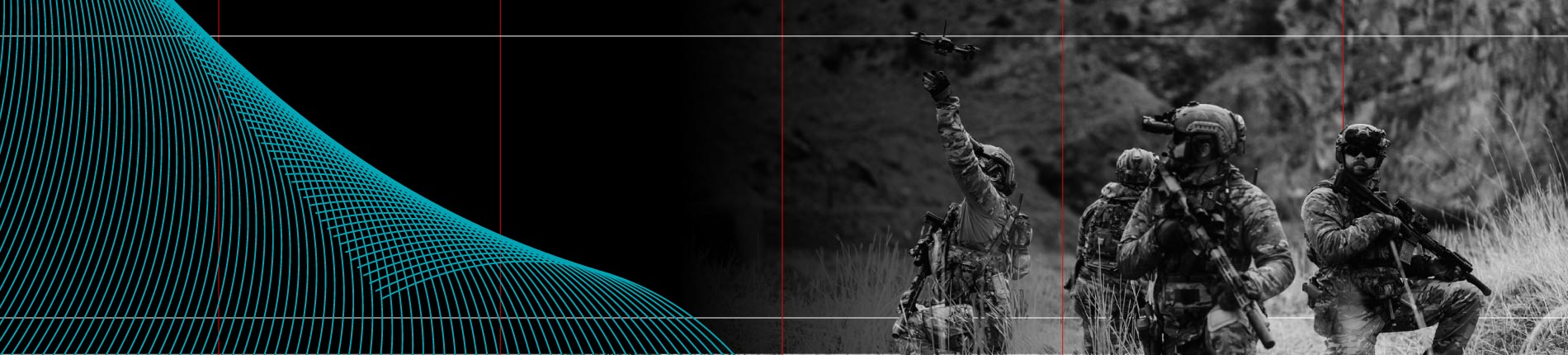
Today, Strike Cell is developing AI agents for unmanned aerial systems (UAS), engineering advanced electronic warfare jamming and spoofing capabilities for maritime settings, and building advanced modeling and simulation environments to train UAS operators.
The agentic solution, for example, will help UAS operators identify and track high-value targets. It combines edge computing and computer vision with AI agents that Strike Cell’s members are encoding with the commander reasoning skills they honed on the battlefield. These skills enable the agents to analyze information in real time and generate potential courses of action along with a transparent rationale for each. This information is sent back to the operators for review, a process that not only improves speed, accuracy, and decision-making in dynamic mission environments but also lessens the cognitive load operators carry.
What makes the approach so effective is the people behind it.
“Our experience with joint SOF missions gives us an inherent understanding of the details and practicalities that are critical to mission success,” says Radke. “For example, the solutions we build will never fail because they don’t meet the tactical or ergonomic needs of forward-deployed operators. Pairing us with developers enables our team to rapidly develop, refine, and integrate advanced technical capabilities that drive contextualized, low-burden decision options for real mission problems—that’s an advantage.”
The close back-and-forth between Strike Cell’s ex-SOF personnel and developers avoids time wasted on tech that will miss the mark when used outside the lab. It also helps move solutions more quickly from initial idea to testable product, with fewer handoffs, less translation, and more direct feedback from people who know what good looks like in the field.
“We are all passionate about supporting the units that we came from—and providing them with the best technology possible,” McGee says. “That real-world experience and mission expertise are critical, and when combined with technical expertise, they can solve the biggest problem at unprecedented speeds.”
Sed et mauris vel mauris porta pretium et a diam. Proin ac mi a augue tincidunt dictum. Vivamus fermentum pulvinar egestas. Duis commodo hendrerit magna, ut feugiat felis condimentum vitae. Phasellus et vulputate diam, nec efficitur arcu. Nunc ornare enim elit, dictum accumsan lacus fringilla eu. Nulla facilisi. Duis a suscipit nibh. Integer dignissim mi diam, sed consequat arcu ullamcorper ut.
Duis ut odio eget sem condimentum laoreet a at metus. Phasellus convallis scelerisque nisl et sagittis. Aenean vitae urna ligula. Cras arcu eros, ultrices vel ullamcorper ac, venenatis ut lorem. Vestibulum congue rhoncus sollicitudin. Mauris vehicula dictum ultrices. Sed augue nisl, ornare eu placerat id, euismod sit amet dolor. Suspendisse fringilla libero id neque consequat vulputate. Praesent gravida condimentum maximus. Donec ac neque id augue fermentum luctus sed in augue. Sed nec tempor turpis. Aliquam sollicitudin nulla nec orci malesuada, porttitor sagittis diam porta. Nullam metus nisl, efficitur sed posuere eget, sollicitudin id dui. Proin convallis enim augue, laoreet finibus ligula consequat vitae. Donec luctus auctor ultricies. Nunc nibh felis, mollis pharetra iaculis in, laoreet ut neque.
