Agentic AI Can Transform Civilian Government

Agentic AI for policy-heavy, or people-centered challenges
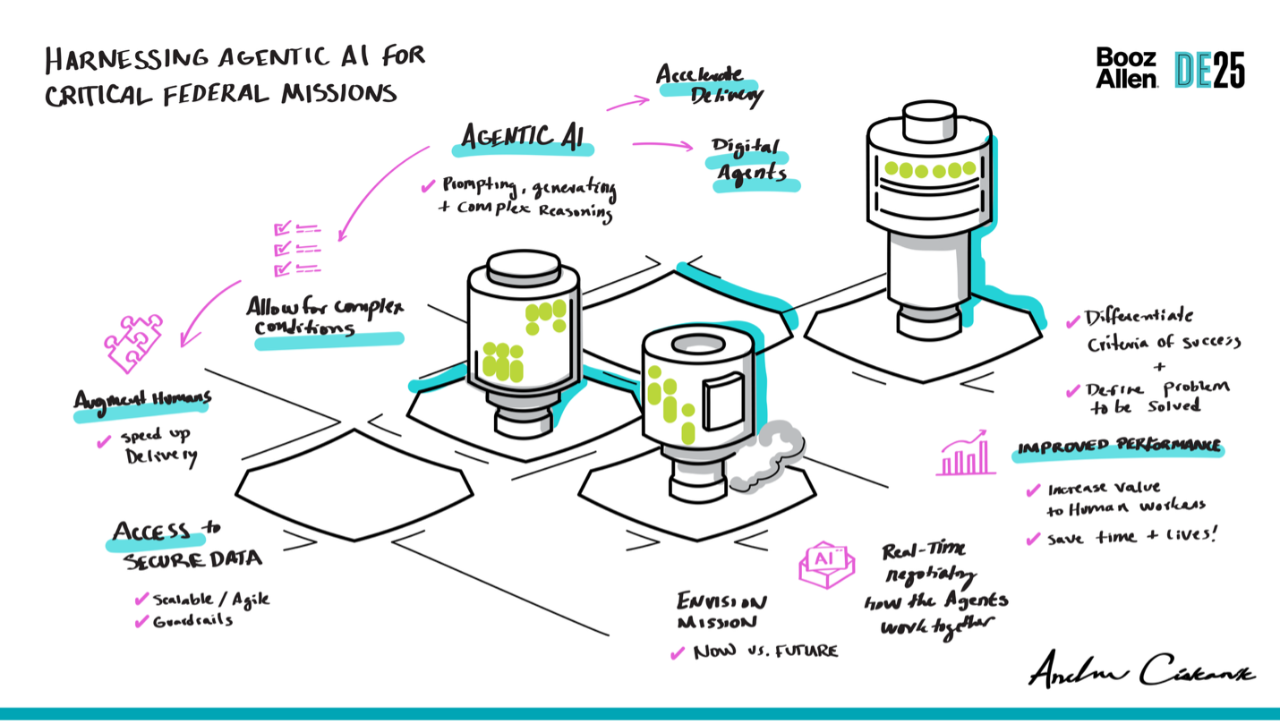
The next era of AI in government isn’t just generative—it’s agentic. Civilian agencies are exploring agentic AI to address intricate policy-heavy, and people-centered challenges within the government. Unlike generative AI systems that can only generate responses, agentic AI can act, adapt, and collaborate to execute multistep processes across enterprise data and systems with impressive speed and resilience. It can also work alongside human teams, augmenting, rather than replacing, their efforts.
Agentic AI speeds up federal mission impact by turning data and intent into autonomous or semi-autonomous actions, with humans in the loop to guide and adapt. This transformation makes federal operations more agile, proactive, and outcome driven. These “AI agents” can independently achieve complex goals with minimal human intervention.
Unlike traditional AI that provides passive or predictive insights, agentic AI takes it a step further. It equips digital agents to sense and understand complex environments, break down goals into actions, and orchestrate and execute entire workflows. Think of it as a team of intelligent digital coworkers that can plan, learn, and execute in real time, all while keeping humans in the loop.
Data is the lifeblood for agentic AI. Without timely, trusted, and context-rich data, even the most advanced AI agents are flying blind. These systems depend on continuous access to structured and unstructured data to reason about and act. This data enables them to learn workflows, detect anomalies, and make real-time decisions. For federal missions, where precision and reliability are paramount, data must be both accessible and secure. The richer the data pipeline, the more contextually aware and smarter the agent. Agentic AI harnesses real-time data to help federal agencies operate more efficiently, adapt swiftly, and deliver high-value impacts at scale.
Agentic AI Powers Mission-Critical Resilience
IT systems in federal operations must operate 24/7 without downtime. Agentic AI introduces autonomous decision making, adaptive response, and continuous learning to complex environments where failure is not an option. Unlike static automation, agentic AI agents can dynamically assess changing conditions, collaborate across systems, and execute recovery or mitigation steps autonomously. This enables real-time resilience, intelligent failover, and mission continuity even in the face of unexpected disruptions or new threats.
“Data serves as the lifeblood for agentic AI. Without timely, trusted, and context-rich data, even the most advanced AI agents are flying blind.”
Boosting Productivity with Agentic AI
Booz Allen is using agentic AI to create intelligent systems capable of planning, reasoning, and acting autonomously across complex workflows. These agents are designed to navigate real-world business processes, such as benefits enrollment, permitting, IT operations, and field logistics, without constant human oversight.
Enabled by the Model Context Protocol (MCP), Booz Allen’s agents can securely access enterprise tools and data, collaborate with other agents, and adapt to new situations on the fly—functioning much like human colleagues. In practice, these digital workers intake documents, assess eligibility, coordinate maintenance tasks, triage IT incidents, and escalate issues only when human intervention is needed. It’s a scalable, human-in-the-loop design that blends autonomy with accountability, propelling mission execution into the era of intelligent automation.
Humans Are Essential
Humans play a vital role in the effective functioning and operation of agentic AI—not just as overseers, but as designers, trainers, collaborators, and ethical stewards. While agentic AI systems can act autonomously, humans define the mission objectives, ensure alignment with organizational values, and provide the domain expertise that informs decision making.
Human oversight is critical for setting guardrails, monitoring for biases or error, and continuously refining agent behavior based on real-world outcomes. In practice, agentic AI augments human capabilities by handling routine or complex tasks, allowing individuals to focus on strategic thinking, innovation, and human judgment. Together, human-machine teams form the backbone of resilient, intelligent, and mission-driven systems.
Booz Allen, in collaboration with industry tech partners, is advancing the development and deployment of agentic AI across mission-critical environments. The best use cases for agentic AI are solving time-sensitive, recurring challenges requiring multiple steps and reasoning to identify and pursue appropriate courses of action. These challenges are ubiquitous across all domains, missions, and the enterprise, presenting limitless opportunities for agentic AI.
Noteworthy early-use cases include:
- AI for Software Engineering and IT Ops: Booz Allen is embedding intelligent agents throughout the development lifecycle—from architectural design to code generation, automated testing, and deployment. These agents act like autonomous teammates, generating and validating code, creating documentation, executing tests, and producing architecture diagrams based on natural language instructions or high-level goals.
- Cyber Defense: By deploying autonomous agents that continuously monitor networks, detect anomalies, investigate threats, and execute on containment activities, agentic AI enables a proactive and adaptive cybersecurity approach. The agents perform real-time triage of alerts, patch vulnerabilities, isolate compromised endpoints, and generate incident reports, ensuring the protection of sensitive citizen data and mission-critical infrastructure across distributed federal environments.
- Treasury/Fraud, Waste, and Abuse: Deploying intelligent agents to autonomously monitor financial transactions, claims benefits, and procurement activities for suspicious patterns or anomalies, agentic AI enhances oversight and accountability. These agents cross-reference data across multiple systems, flag inconsistencies, and launch targeted audits, adapting to evolving fraud tactics and recommending corrective actions to reduce manual investigative burdens.
As the #1 provider of AI and cyber to the federal government, Booz Allen is building agentic AI technologies that transform missions. Leveraging our deep mission understanding and extensive partnerships with industry-leading AI companies, we deliver fast, adaptive, enterprise-grade agentic AI technology that cuts through complexity for federal customers across all sectors.
