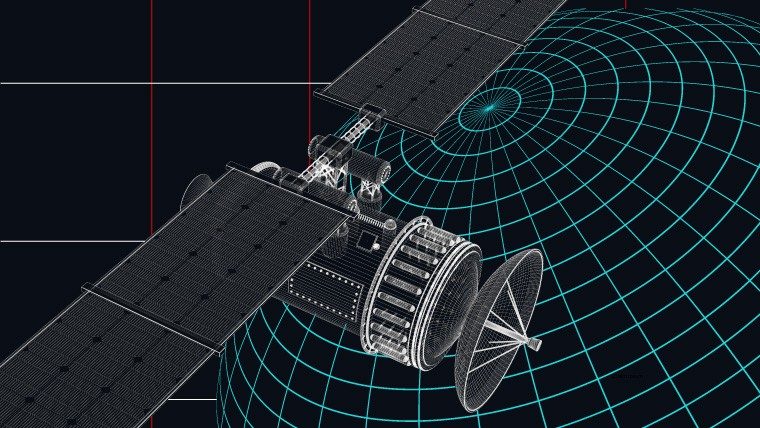
Booz Allen’s VSGS: Virtual Space Ground System
Tomorrow’s satellites demand next-gen infrastructure today
Space missions are critical to defense and intelligence operations. To keep pace, satellites require modern ground systems that infuse artificial intelligence (AI), advanced cybersecurity, and automation to enable agile, resilient operations.
Proliferated satellite architectures are revolutionizing how government organizations build and execute ground systems. Modern systems must accommodate the massive increase in scale of assets and data while ensuring greater resiliency on the ground. Rapid advancements in AI and automation demand more adaptive systems to intelligently control and task on-orbit assets.
Introducing Booz Allen VSGS: Virtual Space Ground System
Booz Allen Virtual Space Ground System (VSGS) is a robust, secure, multi-orbit platform infusing AI and machine learning (AI/ML) to automate and accelerate space asset management. Space is becoming a more contested domain and a geopolitical battleground. This makes the launch of VSGS critical as the U.S. government explores developing a new missile defense system.
Virtual ground systems could play a critical role in a new missile defense system because of the ability to support multiple intelligence collections across different kinds of satellites and constellations in a resilient, secure manner. Given the complexity of missile defense systems, it will likely involve technology from multiple companies. Virtual ground systems ensure all aspects of the system—no matter what company developed them—can seamlessly communicate.
Built on a cloud-agnostic, open-architecture framework that supports some of our nation’s most vital intelligence missions, VSGS rapidly transforms command and control and other mission capabilities. By breaking down an organization’s needs and activities, trend analysis, and decision trees, VSGS optimizes scheduling, planning, and constellation management using a combination of automation and AI.
Transforming Traditional Ground Systems to Be Remote, Intelligent, and Scalable
Agentic AI for Automated Command and Control
With Booz Allen VSGS’s agentic AI, operators can schedule a task on a specific sensor within a designated time frame, or optimize collection plans across multiple sensor types across a massive, proliferated constellation, and an army of AI agents with specific training against their aspect of the ground ecosystem handles it seamlessly. This technology acts as a digital operator, autonomously managing and optimizing satellite operations—especially valuable for large constellations. It can dynamically schedule, task, and re-task satellites in real time; respond to mission changes; and adapt to evolving operational needs without human intervention. This level of automation ensures rapid response, increased mission resilience, and efficient use of resources across proliferated satellite networks.
Data Management
Harnessing the power of an integrated data layer across multiple intelligence collection types, Booz Allen VSGS enables rapid data distribution and processing with granular security for government, defense, and U.S. allies and partners. An agency can opt to add cross-domain services, allowing an operator to protect classified sources while tapping into disparate, unclassified data
Our method builds common services, such as command and control, into an accelerated software platform. BASE-C, a robust multi-cloud platform service, provides infrastructure, hosting, and DevSecOps—with zero trust built in.
In weeks or even days, agencies gain the capability to use accredited services that are highly scalable, enable high throughput, and provide resiliency as well as automation. Using VSGS, operators can securely manage constellations in a variety of orbits, with the adaptability built in for research and development to core intelligence constellations.
Explore VSGS Advantages
- Accelerates Modernization Through Quick Deployment on the Client’s Preferred Cloud Service
- Reduces the Satellite Tasking Process from Hours—or Even Days—to Just Minutes
- Frees Operators to Manage Missions Anywhere, with Remote Access Around the Globe
- Eliminates the Need for Specialized Hardware and Equipment
- Integrates Seamlessly to Work Across Terrestrial Networks, 5G, and Tactical Networks