
Automating Digital Compliance with AI
A zero-trust, LLM-driven approach
A large federal health organization managing an extensive digital footprint faced a growing challenge: maintaining consistent compliance across hundreds of public-facing websites. With hundreds of sites and dozens of policies that required quarterly evaluation, the manual review process became overwhelming, consuming tens of thousands of labor hours annually. Reviews were slow, inconsistent, and highly prone to human error, making it nearly impossible for teams to monitor compliance at scale or proactively address risks. The organization needed a faster, more reliable way to evaluate digital properties without expanding staff or compromising quality.
Solution
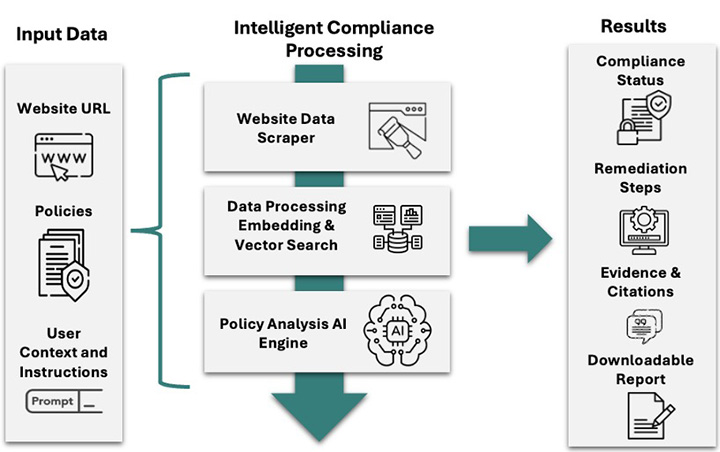
To meet this demand, the Booz Allen team deployed an intelligent AI-driven compliance agent built on an open-source, governed GenAI platform. The solution automated end-to-end compliance evaluation by combining advanced web crawling with large language models capable of analyzing site content against defined digital policies. Using embeddings for semantic search and comparison, the agent produced detailed assessments, complete with policy citations, evidence, and recommended remediation steps. Its architecture supported multiple LLMs and cloud providers, enabling flexible optimization for performance and cost. Parallel processing allowed multiple policies to be evaluated simultaneously, while human oversight remained a core feature, ensuring accuracy, trust, and responsible AI use throughout the workflow.
Impact
The AI-enabled approach transformed the organization’s compliance operations. Review time dropped from more than 23,000 hours annually to under 2,000, dramatically increasing throughput without expanding the workforce. Benchmarking showed that AI-generated assessments closely matched human reviewer accuracy, providing confidence in both recommendations and remediation guidance. With systematic, repeatable analysis now in place, the organization can proactively manage compliance across its digital ecosystem, reduce operational risk, and scale evaluation processes as its digital footprint grows. The result is a modernized compliance capability that is faster, more reliable, and far more sustainable than manual review alone.
Efficiency Gains
- Reduced estimated annual review time from 24,000 hours to 2,000 hours using AI automation
- Enabled policy evaluations to run in parallel, dramatically increasing throughput
- Allowed compliance operations to scale without increasing team size
Quality and Accuracy Improvements
- AI agent demonstrated accuracy comparable to human reviewers in benchmark testing
- Provided consistent, evidence-based remediation steps, reducing variability in assessments
- Enabled systematic, repeatable analysis across all digital properties
Risk Reduction and Compliance Strengthening
- Shifted the organization from reactive checks to proactive compliance management
- Reduced risk exposure by identifying and correcting issues earlier and more reliably
- Established a governed, audit-ready AI workflow that strengthens digital oversight
Tech Stack
AI and Large Language Models
- LLM-powered content analysis
- Embeddings for semantic search and policy comparison
- Multi-model support (LLM-agnostic design)
Agentic Workflow Architecture
- AI agent automation for end-to-end compliance checks
- Human-in-the-loop validation for accuracy and oversight
- Parallel processing to handle multiple policies at once
Cloud Infrastructure and Scalability
- Cloud-native deployment for performance and scaling
- Ability to run policy evaluations in parallel to reduce processing time
Open-Source PALM Platform
- Governed GenAI framework for secure deployment
- Built-in access controls and auditability
- Support for multiple cloud service providers
