
AI for Legacy Systems: A Breakthrough in Transformation
An AI-enabled approach to legacy transformation
Transforming mission-critical legacy systems often traps organizations between soaring maintenance costs and the high risk of system replacement. Many large enterprises still rely on software built on decades-old programming languages, customized repeatedly over time and supported by an increasingly scarce talent pool. These systems typically contain deeply embedded business logic that is extremely difficult to extract or understand, making traditional transformation approaches slow, expensive, and error prone. In some environments, the cost of maintaining legacy applications reaches hundreds of millions of dollars annually, while transformation efforts stall because no scalable, cost-effective way exists to analyze the underlying codebase. Organizations are left with an unsustainable choice: continue investing in outdated systems or embark on multibillion-dollar replacement programs with significant operational risk.
A Revolutionary AI Solution for Legacy Systems Transformation
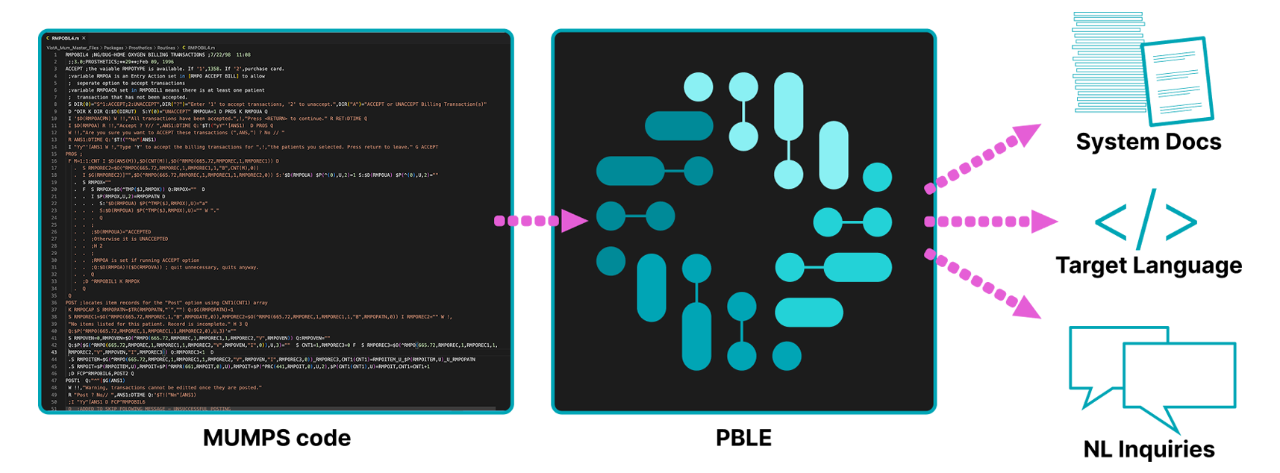
To address this longstanding challenge, we brought in the Booz Allen Pseudocode & Business LogicExtractor (PBLE) to speed up the customer’s transformation. PBLE is an AI-powered code translation and documentation engine that changes legacy transformation from a manual, expert-driven effort into a scalable, automated process. Instead of requiring specialized programmers to decode legacy languages, PBLE analyzes source code and produces clear, actionable documentation that is readable for modern development teams and mission stakeholders. In a large enterprise proof of concept, PBLE analyzed hundreds of legacy source files in just hours, an effort that would traditionally require months of expert analysis. While PBLE does not generate production-ready applications, it produces comprehensive documentation that organizations can use to make informed transformation decisions, accelerate onboarding, reduce defects, and support incremental or full-scale transformation strategies.
Impact
The AI-enabled approach dramatically changes the economics and feasibility of legacy transformation. Documentation costs were reduced by more than 85%, while completion times accelerated 15×, shrinking multi-year analysis efforts into weeks. Expert review hours dropped by more than 67%, allowing specialized staff to focus on high-value transformation activities rather than low-value code discovery. Most importantly, organizations gained complete insight into their legacy systems before beginning any conversion work, reducing project risk, preventing costly defects, and enabling more flexible transformation roadmaps. What was once viewed as prohibitively complex, understanding and transforming a massively customized legacy system, becomes achievable through AI-driven analysis, structured documentation, and data-backed decision making.
Cost Reduction
- Documentation and analysis costs reduced by over 85% compared to traditional methods
- Total transformation preparation costs dropped from ~$2.28M to ~$321K
Workforce Efficiency
- Expert review hours reduced by 67%+, freeing specialized staff for higher-value work
- Eliminated dependence on scarce legacy-language developers through AI-driven translation
Transformation Speed
- Transformation analysis accelerated 15×, shrinking timelines from 790 days to ~50 days
- Hundreds of legacy files analyzed and documented in hours instead of months
Quality and Risk Reduction
- Complete system understanding before conversion, reducing downstream production bugs
- Improved decision making on what to transform, refactor, or retire through structured documentation
- Lowered technical risk by enabling incremental, testable transformation strategies
Tech Stack
- AI-driven code translation engines
- Large language models (LLMs) for logic extraction and interpretation
- Automated documentation generation workflows
- Static analysis tools to parse legacy programming languages
- Automated extraction of embedded business rules and logic
- Scalable ingestion pipelines for thousands of legacy source files
- Cloud-enabled parallel processing for rapid code translation at scale
- Compute environments optimized for high-volume analysis
- Human-in-the-loop validation mechanisms for accuracy and governance
