Booz Allen Sit(x)® Simplifies Situational Awareness
A cost-effective way to connect teams at the edge
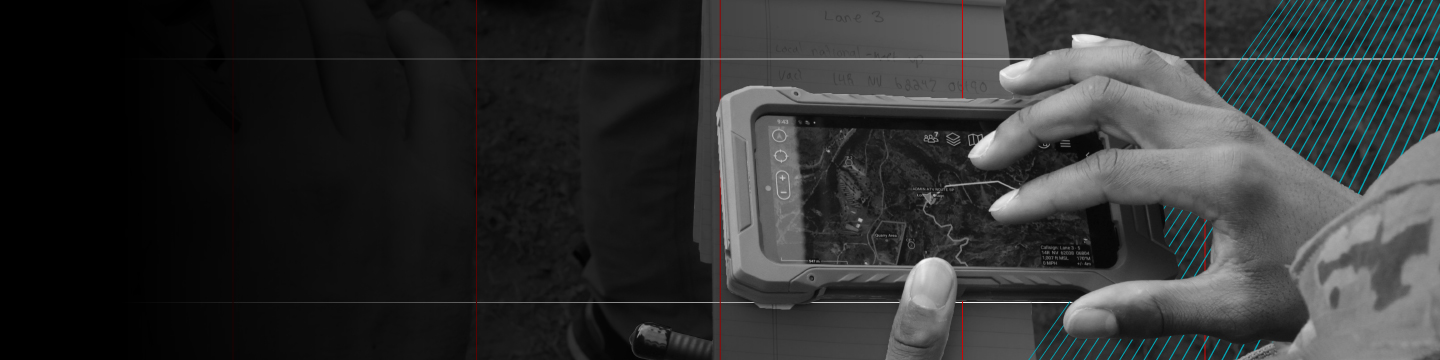
The Tactical Assault Kit or Team Awareness Kit (TAK) is a government-developed software platform that provides warfighters in forward-deployed areas and law enforcement personnel in the field with real-time information about their fellow unit members’ whereabouts and the surrounding area’s geographical features.
It allows them to maintain a common operating picture, draw shapes on maps, and chat with one another to coordinate tactics without relying on constant radio voice time. It also offers advanced features that enable a user to control multiple unmanned aircraft systems from the palm of their hand or drop pins on a map and get the optimal route between two points.
All these features increase the likelihood of mission success and help keep warfighters and law enforcement personnel safe.
Taking TAK to the Next Level
Booz Allen Sit(x) takes the TAK capability to the next level. While TAK can operate offline, Sit(x) provides an advanced infrastructure that enables teams to coordinate in a secure online environment. It has changed the game for operations involving various branches of the military or heavily coordinated efforts that bring federal law enforcement agencies and state and local governments together, like providing aid during a natural disaster or security at a mega sporting event like the Super Bowl.
Originally developed for the military’s special operations community, Sit(x)-enabled TAK has expanded beyond the battlefield and can support more than 500,000 users across local, state, and federal organizations—all from a familiar, intuitive platform that can be set up in minutes without any technological training.
“Sit(x) connects users in an affordable, safe, and simple way,” says Todd Krokowski, product lead for Booz Allen Sit(x). “In a matter of minutes, users can add members to a team—no matter the affiliation—streamlining communication and collaboration.”
Coordination at the Edge
Sit(x) is designed for “edge” environments—extreme locations like deserts or remote islands where broadband and 5G are unavailable. In the past, warfighters might have been tasked with setting up their own TAK servers in these areas.
“One of the origin stories behind Sit(x) was a moment when I got a call from some guy out in a battlefield asking for help setting up a TAK server,” Krokowski recalls. “They were reading from an instruction manual, and they were like: ‘First of all, what is Linux?’ That was one of our a-ha moments. We realized: If you’re not an IT person, this is not a straightforward process. We built the Sit(x) platform so a totally nontechnical user could control their own setup, get online in minutes, and be confident that everything is secure.”
Integration With Advanced Tech
In addition to its intuitive, point-and-click design, Sit(x)-enabled TAK also supports advanced integrations with other technologies, such as:
- Anduril’s Menace: Sit(x) is optimized to run on Anduril’s Menace compute and communications systems, providing a shared coordination layer across mission partners. It connects users of Anduril’s Lattice software with TAK-based and other partner systems, enabling coalition teams to share situational awareness information without requiring a common architecture across all partners or new end-user training.
- Unmanned Systems: Users can live-stream video from drones to scout areas before entering, helping them avoid danger and refine strategies.
- Tactical Tracking: In some jurisdictions, law enforcement officers can fire a projectile to tag a vehicle's bumper, allowing aircraft and ground units to follow it on the map without a high-speed pursuit.
Sit(x) also offers critical security advantages. Users have total control over who has access to data, and when an operation is over, the infrastructure can “auto-expire,” leaving no digital footprint behind.
Proven Resilience in the Field
The platform’s impact is already visible across various high-stakes scenarios:
- National Defense: Sit(x) is currently used in all 50 states and four territories in support of activities like southern border operations and disaster relief.
- Disaster Recovery: During Florida hurricanes, the user base grew to 1,000 users overnight without requiring Booz Allen’s direct intervention.
- Public Safety: In 2023, the Phoenix Police Department used Sit(x) to coordinate security for the Super Bowl, connecting half a dozen law enforcement organizations in just 30 minutes.
- International Support: The platform has been used in foreign countries to connect indigenous partner forces, allowing U.S. personnel to coordinate with them directly and to remotely monitor operations through an easy-to-use interface.
Cost-Effective Innovation
Sit(x) is what’s known as a “Software as a Service (SaaS)” model—software hosted in the cloud or on the edge that is accessible for a subscription fee. This approach benefits users, who avoid the technically intense requirements of installing, securing, and maintaining bespoke systems. What’s more, users can pay for access when they need it and stop when they don’t, making it a flexible tool for modern defense. And Sit(x) is available on AWS Marketplace, where it can be procured through streamlined federal acquisition pathways without lengthy contract negotiations.
Using Sit(x), agencies can reduce costs from a third to half compared to traditional government infrastructure.
“Defense is about so much more than jets and missiles,” Krokowski says. “We’re creating the software and systems our warfighters need to coordinate assets and stay safe in the field.”
