
Digital Threads Tame Engineering Complexity
Integrate lifecycle data to accelerate system delivery
By John Silvas and Mark Pflanz
In today’s fast-paced and competitive national security landscape, government and industry face a constant foe: complexity. Project teams must design and deliver mission systems that not only achieve breakthrough performance but also reduce costs and accelerate delivery timelines. Meeting these ambitious goals often requires the integration of cutting-edge technologies, such as artificial intelligence, advanced sensors, hypersonic propulsion, and directed energy. These challenges are further intensified by adversaries that rapidly introduce new capabilities, shortening development cycles from years to months.
As a result, enterprises face an overarching systems development challenge due to this demanding engineering environment. Major defense programs now generate terabytes of engineering data across multiple systems at multiple contractor and government offices. Interdependencies across this data often become too complex for leaders in charge of development to manage effectively. Many teams still rely on manual processes and disconnected tools that obscure critical interdependencies until testing or deployment. The scale of complexity hides the accumulation of technical debt, forcing program managers to accept performance shortfalls or cost and schedule overruns when problems are finally discovered.
Effective use of digital threads is critical to overcoming these challenges. A digital thread is an extensible and configurable analytic framework that captures the interplay of technical data, software, information, and knowledge in the digital engineering ecosystem.1 By integrating data across entire program lifecycles, digital threads create real-time visibility into complex system interdependencies at the speed of development. For federal leaders overseeing large-scale technical initiatives, digital threads have the potential to enable predictive program management and data-driven decision making, transforming engineering management from siloed and reactive to fully integrated, proactive, and seamless.
1DOW Instruction 5000.97, Digital Engineering, 21 December 2023, p. 12.
Speed Read
Digital Threads Combat Complexity: Integration of digital threads enables programs to understand and manage complex system interdependencies.
Transformative Policy Changes: The Department of War’s Digital Engineering Strategy mandates adopting digital threads, as the inability to capture and manage system interdependency leads to adverse outcomes.
Authoritative Data Is Non-Negotiable: Configuration-managed, single-source truth provides the foundation for effective management of interdependencies within a digital thread.
Better Data Interoperability Is Needed: New data interoperability standards are needed to bridge the current fragmentated nature of engineering data spanning vendor and domain platforms that hampers digital thread adoption.
AI-Powered Advancements: AI technology can help accelerate more widespread adoption of digital thread capabilities by minimizing complexity at scale.
Policy Mandates Initiate Engineering Transformation
The government’s engineering transformation formally started in 2018 with the Department of War (DOW) Digital Engineering Strategy, a plan to integrate digital ecosystems supporting the full defense acquisition lifecycle. This effort gained additional momentum with DOW Instruction 5000.97 (2023), which requires new programs to incorporate digital engineering and includes guidance specifying the use of digital threads. Figure 1 shows how digital threads capture the interdependency of multiple systems design elements across the lifecycle.
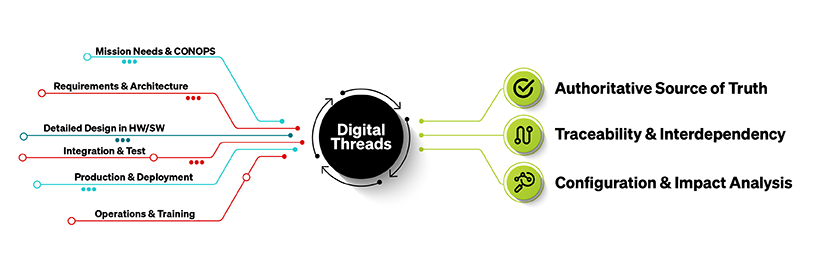
As a result, defense leaders are approaching digital threads as part of system development to improve engineering and acquisition effectiveness. Digital threads are also emerging in other federal sectors. Civil agencies are exploring applications within their acquisition portfolios, recognizing that digital threads offer capabilities essential for managing growing system complexity. One example: NASA’s Artemis program incorporates digital thread implementation for mission-critical systems.
Interdependency Imperatives
Adverse outcomes occur in digital engineering when program teams can’t adequately manage system interdependency given the inherent complexity. Unlike digital twins, which simulate components or processes, digital threads trace information flow across the lifecycle from initial requirements through operational sustainment. When engine requirements influence wing design, which affects fuel system specifications, which determine maintenance procedures, which shape training requirements, the digital thread captures these cascading relationships and supports predictive impact analysis before changes occur.
Comprehensive interdependency mapping extends beyond design and manufacturing into operations, where program managers can monitor system performance, track maintenance records digitally, and use predictive analytics to schedule maintenance before failures occur. These capabilities directly support lifecycle cost reduction and enhance operational readiness.
The dangers of obscured interdependencies are increasingly recognized. According to reports, Boeing’s 737 MAX crashes partially resulted from inadequate integration between the aircraft’s Maneuvering Characteristics Augmentation System and pilot training programs. Engineers understood individual component behaviors, but it was challenging to anticipate complex system-level interactions under all operational scenarios. A digital thread capability might have revealed these interdependencies during design phases.
The Architecture of Authoritative Truth
Digital thread capabilities that help organizations better understand interdependencies and manage complexity depend on an underlying authoritative source of truth. Technical data is authoritative when it is configuration-managed, accurate, current, accessible, and recognized as a sole source of truth. Any digital thread analysis that does not employ authoritative data is not only meaningless but could also be harmful.
Legacy systems engineering approaches scatter requirements in document repositories, designs in separate computer-aided design (CAD) systems, and test data across multiple databases, creating information silos that prevent comprehensive program visibility, hide the accumulation of technical debt, and complicate efforts to use authoritative data. Digital engineering restructures how programs manage technical data throughout system lifecycles using a digital engineering framework. This framework consists of a digital engineering ecosystem, digital models, digital twins, digital threads, and digital artifacts connecting all phases of the system lifecycle.
For “new start” programs applying a born-digital approach, the capture, assembly, and management of authoritative technical data into a configuration-controlled technical data package can be executed from the beginning. Existing programs face a heavier lift. They must link multiple islands of technical data scattered across development silos. This integration requires sophisticated backend work to establish relationships between databases that were never designed to communicate, creating a two-way data flow where changes in one tool automatically update related information in connected systems, often at different security classification levels.
Whether “new start” or existing, program teams must ensure that data used in digital thread analyses is authoritative. They can most easily achieve this using a product lifecycle management (PLM) capability, but it is also possible via direct integration of existing data management sources. Whether a dedicated PLM system is used, or the program team selects a direct integration engine, the resulting digital thread capability helps the team reach better development outcomes by understanding interdependency, propagating changes across the design, and managing complexity from conception through disposal.
Addressing Technical Data Interoperability
Programs developing complex systems select and employ system development approaches for a range of factors. Key suppliers or partners may use specific engineering tools that can’t be easily switched. Legacy programs often grew up with a hodgepodge of software and database solutions that are impractical to centralize. Customers may impose development tool constraints.
Defense systems amplify these challenges by requiring information to exist simultaneously at multiple classification levels. While unclassified data captures the broadest system data, sensitive details exist at higher classification levels. Maintaining synchronized versions across security boundaries while preserving digital thread integrity remains a significant technical issue.
Major engineering tool platform providers offer comprehensive but incompatible solutions, creating “walled gardens” that resist integration. Metadata translation between these systems can introduce information loss and errors that compound across multivendor programs. Realizing the potential of digital thread capabilities drives a need for technical data interoperability, likely via common data interchange standards.
Data interchange standards have solved similar problems before. Transmission Control Protocol/Internet Protocol (TCP/IP) standards allow internet systems to interoperate. DOW uses Link-16 to share data across multiple platforms and even with allied partners. Organizations such as DOW, the National Institute of Standards and Technology, the Object Management Group, the Institute of Electrical and Electronics Engineers, and the International Council on Systems Engineering have been centralizing interchange standards and unifying technical languages for years. A similar effort will be required to fully realize the power of digital thread analyses.
Overcoming Adoption Challenges Using AI
As discussed earlier, complex systems in development or already in existence include large technical datasets with extensive interdependencies. While the digital thread concept considers the entire system lifecycle, let’s consider the scale of this issue starting with just the initial requirements phase. Many complex systems have thousands of requirements with expanding branches that each extend outwards into architecture, CAD, software, manufacturing, testing, and sustainment. The scale of interdependency gets very large, especially across the lifecycle.
Addressing the scale of this many interdependencies implies several realities. First, for “new start” programs, the day-to-day practice of systems in development must change so that engineers capture interdependencies during development. This is a process change. Second, for existing systems, automated approaches will eventually be required because of the scale problem discussed earlier. Importantly, any automation approach will require a robust approach to ensure the validity of its results.
AI holds the power to address this second reality—the need for automation. Today, AI tools can automatically generate system architectures, create requirements from high-level specifications, and enable natural language queries of complex engineering databases. The potential exists for agentic AI systems to evaluate the technical data packages of existing systems to identify interdependencies and present that information to human engineers for validation.
AI integration offers several transformative capabilities for federal programs:
- Generative Engineering: AI can help engineers devise multiple design approaches for new requirements, tackling the “blank-page problem.”
- Domain Bridge Elimination: Natural language interfaces enable experts to access multidisciplinary information without mastering complex software.
- Automated Interdependency Discovery: AI can identify and establish traceability between inter-related system data elements in the technical data package (TDP) to overcome the scalability issue discussed earlier. Yet to be developed, this AI capability offers the greatest transformation potential because legacy programs far outnumber new-starts, and most systems exhibit complex interdependency.
Programs that accelerate responsible AI adoption can maintain advantages in complex systems development while transforming how engineering teams operate across traditionally separate disciplines.
A Framework to Accelerate Implementation of Digital Thread Capabilities
Digital thread implementation requires near- and long-term systematic approaches at three levels:
- Program Level: Initiate pilot efforts using real delivery programs rather than isolated experiments, focusing on upcoming acquisitions with committed leadership support.
- Academic and Professional Society Level: Update engineering processes for new systems to be born digital, with new workflows that account for digital threads baked into institutional processes. Prioritize targeted training that bridges traditional engineering skills with digital capabilities.
- Oversight, Interagency, and Industry Level: Lead the development of data interchange standards to ensure engineering tools effectively share data across technical domains and the development lifecycle. Agencies should drive open standards to avoid vendor lock-in. Develop measurement frameworks to assess maturity. Vendor management should incentivize integration success.
Parting Thoughts
International competition has intensified around technological speed and integration. China’s military-civil fusion strategy targets rapid integration between commercial innovation and military applications, treating engineering agility as a competitive advantage. In this geopolitical context, traditional engineering approaches risk ceding the edge in complex systems development and deployment.
Digital threads represent the potential for sweeping, infrastructure-level transformation, requiring coordinated federal leadership rather than agency-by-agency efforts. Organizations that successfully implement comprehensive digital engineering approaches will gain the ability to accelerate development, deployment, and maintenance of complex federal systems in an increasingly contested global environment.
