Counter AI Defeats AI Adversaries
Written by Aaron Sant-Miller

Defenders deploy AI minefield to gain time and control
Defenders have used deceptive tactics to safeguard networks for 40 years. Clifford Stoll set the pattern in 1986, holding an intruder on the line at Lawrence Berkeley National Laboratory with a directory of fabricated defense documents, an exploit he describes in The Cuckoo’s Egg. Deceptive practice moved from there to the Honeynet Project, which formalized honeypots, or traps, in the late 1990s, and on to today’s enterprise deception platforms.
In that time, the basic idea hasn’t changed: Attackers act only on what they perceive, and defenders can aggressively shape that perception. What has changed is that today’s attacker is increasingly powered by an AI model interpreting and navigating an environment, rather than just a human intruder drawing on their experience. The time is now to refresh this proven playbook by using counter AI to counteract the attacker’s velocity.
Rebalancing Cyber Defense by Turning AI-Powered Attackers Into the Prey
As we detailed in our recent report, When Cyberattacks Happen at AI Speed, AI-powered attacks happen significantly faster, creating an asymmetry in cyber operations. AI accelerates all facets of the cyber kill chain, including reconnaissance, exploitation, and lateral movement. While defenders can harness AI as well, workflows remain inherently reactive, and essential AI security guardrails limit model flexibility and agility. Although defensive workflows can still work, they carry less margin for error when the attack cycle outruns the decision cycle.
Speed also costs the attacker something, and that’s where defenders can look for a new advantage. An autonomous agent rapidly interprets its environment through AI model-driven cues: read what is there, judge what matters, pick tools, and plan the next step. It weighs what it was given and moves on—a behavior defenders can exploit. Shaped context influences machine decisions the same way it has always influenced human ones, and defenders control most of the environment an attacker’s AI has to read.
Counter-AI strategies exploit the adversary’s reliance on this AI-driven interpretation and decision making. By shaping what the attacker’s AI sees, trusts, and acts on, defenders can collect telemetry, redirect the session, or trigger containment before the attack reaches real assets.
Transforming Agent Traps Into Active Defense
Organizations can now adapt false credentials, decoy services, planted files, poisoned reconnaissance data, and controlled routes away from production to thwart autonomous adversaries. When employing counter-AI methods, deception becomes the means to deliver the solution. As the adversary consumes defender-curated content, the adversary’s agents will feed specific model breaks back into the attacker’s engine. While traditional deception looks to distract or uncover the attacker, counter AI uses deception as AI traps, targeting an agent’s reasoning loop for systemic failures and critical intelligence collection.
Some traps act as lures that attract attention: a credential, file, or service that falsely reads as a foothold. Some burn time, holding an agent in a path that produces nothing. Others track and expose methods, showing how the agent reasons, the tools it uses, and even the human-curated prompts that initiated and controlled the campaign. Some traps can even control the attacker’s AI, orienting it to believe defender deceptions are its critical infrastructure and exfiltration source.
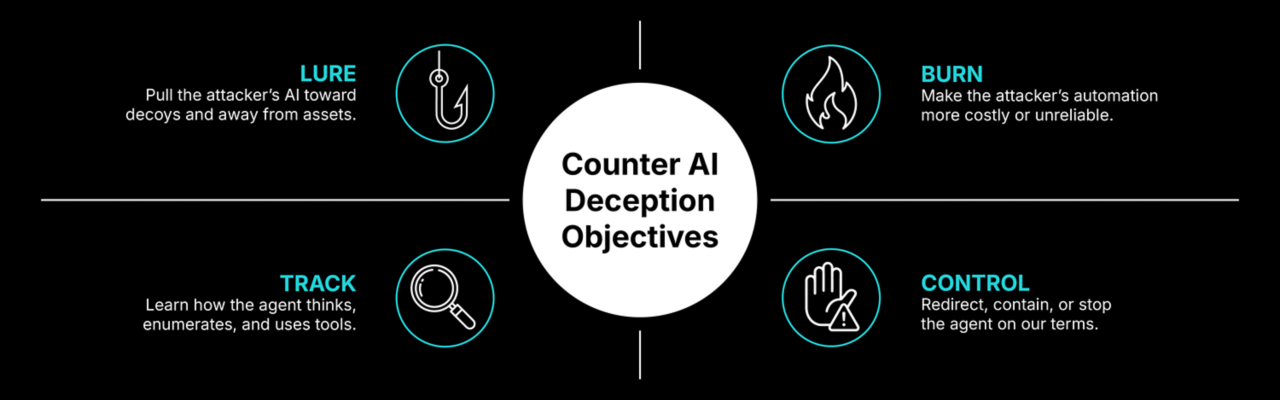
This results in rich intelligence and the opportunity to manipulate, redirect, or co-opt the model. End to end, when an agent engages, defenders collect telemetry, redirect the session, or trigger containment while the attack is kept separate from real assets.
Of course, a network full of random traps isn’t a defense. Deception starts with intent: a playbook that specifies where traps go, which attacker behaviors they should provoke, which signals matter, and what happens when one fires. Placement follows sensitivity—extended engagement in low-risk areas to gather intelligence, fast action near critical systems. The toolkit spans decoys, canaries, fake credentials, tarpits, misleading artifacts, and disruption techniques.
During an attack, a counter-AI engine executes that playbook: monitoring trap activity, collecting telemetry, adjusting within defined limits, and invoking controls already in place, such as endpoint isolation or firewall blocks. Near a high-value system, that might mean seeding credentials that pull an attacker toward a decoy service, watching how they behave, then triggering containment.
Over time, a learning loop keeps the system current—testing models against the traps, finding where agents misread their environment, and feeding those failures back into new playbooks.
Coordinated playbooks cut attacker coverage by more than 95 percent in controlled testing.
What Our Research Shows
Booz Allen tested AI-enabled red-team workflows in a controlled environment, gave each a fixed 2-hour window, and measured attacker success (via total access, compromise, or exfiltration goal achievement). We tested across multiple AI model back-ends and autonomous red-team harnesses, including proprietary, model-provider, and open-source tools.
Attacker success fell as deception moved from simple decoys to coordinated playbooks tied to response controls, and the strongest configuration tested cut attacker success by more than 95 percent against the no-deception baseline. Deception techniques that disrupted the model’s reasoning affected more than two-thirds of attacker decisions and provided rich intelligence on attacker goals, methods, and capabilities.
Counter AI pushed the attacker’s AI into hesitation and error. Its AI evaluated false paths, rechecked assumptions, and wasted effort. A fast automated workflow became a slower, noisier engagement that threw off more usable telemetry, which gave defenders better chances to redirect or contain the session short of high-value assets.
In live-scenario testing, defenders triggered containment through existing security controls within seconds of an autonomous attacker engaging a deployed trap. Counter AI moved past watching and into automated defensive action.
Introducing Vellox Labs™ Guile
Vellox Labs™ Guile from Booz Allen puts counter AI into production. It combines AI-aware disruption primitives, preconfigured playbooks, telemetry from live attacker engagement, and integration with the defensive controls already in place.
Guile solves placement and follow-through, including which lures and traps belong in which parts of an environment, how an attacker’s AI is responding to them, and when to trigger containment before a session reaches the systems that matter. It buys defenders time now, while they keep maturing the automation and end-to-end security models that AI-speed threats demand.


Conclusion: Rebalancing the Time Advantage
Defenders can reclaim the speed advantage through counter AI. Advanced methods, when employed through deception tradecraft, can expand traditional solutions to scale solutions against machine-speed attackers. By not just shaping what an attacker sees but also how it thinks, communicates, and shares information, counter AI removes the speed advantage automation gives attackers.
Security leaders have long treated deception as a research topic or an optional layer to consider once fundamentals are addressed. However, our experience suggests organizations should consider an alternative approach to deception. Rather than just distracting attackers, organizations should use it as a tool to employ active control over autonomous attacks.
Counter AI complements detection and response. Attacker autonomy will keep increasing, and more of each intrusion will run on cues the defender can shape. The most resilient organizations will shape machine perception with the same rigor they have traditionally applied to human perception and buy time their defenders can use.
